--%>

Cost structure characteristic in purely competitive industry

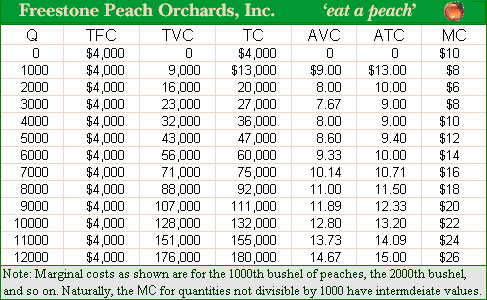
When Cling Peach Orchards has a cost structure characteristic of peach orchards into this purely competitive industry, when the long run new competitors would most likely enter the market providing the wholesale price per bushel of peaches exceeded: (i) $3.00 per bushel of peaches. (ii) $7.67 per bushel of peaches. (iii) $8.00 per bushel of peaches. (iv) $8.60 per bushel of peaches. (v) $9.00 per bushel of peaches.
770_Profits and Losses1.png

Hello guys I want your advice. Please recommend some views for above Economics problems.

   Related Questions in Microeconomics

  • Q : What is APS What is APS? APS = S/Y. It

    What is APS? APS = S/Y.It is the ratio of income to saving which is termed as APS.

  • Q : Bookkeeper problem regarding Moral

    I have a problem in economics on Bookkeeper problem regarding Moral Hazard. Please help me in the following question. When a bookkeeper embezzles $1 million and flees to the Brazil after 22 years on the job, there is a trouble of: (i) Fugitive derelic

  • Q : Policies for overall demanding labor

    Policies which raise the overall demand for labor and maintain unemployment rates low are: (w) significant for the success of any other programs to reduce poverty. (x) sufficient measures to reduce the incidence of poverty. (y) not relevant to the suc

  • Q : Firms and the Transaction Costs Can

    Can someone help me in finding out the right answer from the given options. The survival of all firms eventually depends on the capability to: (i) Decrease transaction costs to consumers. (ii) Produce economic gain. (iii) Maximize the value of output for given cost. (

  • Q : Demand curve for Complementary Goods

    The ban on assault weapons enacted in the year 1994 lapsed in the year 2004. Prices for assault weapons fell in year 2004 since the only way to get such guns throughout the ban was via the black market. This modify in the law in year 2004 is most probable to shift the

  • Q : Compute Gini Index The areas

    The areas illustrates in this Lorenz diagram can be used to compute a Gini index as: (i) (cow + pig)/cow. (ii) cow2/(cow + pig).  (iii) pig2/(cow + pig). (iv) cow/(cow + pig) (v) (cow + horse)/pig.

    Q : Price elasticity of demand as the

    The price elasticity of demand is approximately measured as the absolute value of as: (1) (% change in Q) / (% change in Y). (2) ratio of the slopes of demand relative to supply. (3) (% change in Q) / (% change in P). (4) constant slo

  • Q : Help The problem of asymmetric

    The problem of asymmetric information is that: a) neither health care buyers nor providers are well-informed. b) health care providers are well-informed, but buyers are not. c) the outcomes of many complex medical procedures cannot be predicted. d) insurance companies are well-informed

  • Q : Stickiness of prices in oligopolistic

    The "kinked-demand-curve" model was developed into the 1930 year in part to help describe: (i) barriers to entry in oligopoly markets. (ii) the allegedly excessive stickiness of prices into oligopolistic industries. (iii) how competitive industries be

  • Q : Screening and Credentialism The critics

    The critics of ‘credentialism’ suppose that firms making employment decisions tend to mainly rely too heavily on: (i) Personal contacts. (ii) Personality testing. (iii) Past experience. (iv) Job interviews. (v) Formal education and trainin