--%>

Contestable Markets

When consumers ultimately cannot distinguish one roasted chicken dinner from other, when roasted chicken dinners are produced within a constant cost industry, and when no barriers to entry or exit exist, in that case the long-run equilibrium price per generic chicken dinner will be approximately: (1) $12. (2) $10. (3) $8. (4) $6. (5) $3.
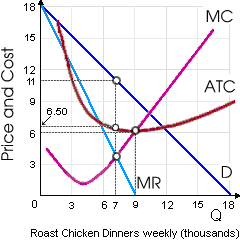
2435_Market Power and Short Run Economic Profit.png

How can I solve my Economics problem? Please suggest me the correct answer.

   Related Questions in Microeconomics

  • Q : Case study on Microeconomics Hello, I

    Hello, I did attach case study on Microeconomics. Regards,

  • Q : Average of incurring total fixed costs

    This brickyard is incurring total fixed costs which average about: (1) $200 daily. (2) $300 daily. (3) $400 daily. (4) $500 daily (5) $600 daily.

    Q : Hicks Model of Bargaining The John

    The John Hick’s bargaining model recommends that the union wage demands and a firm's wage provide: (i) Might be so distinct that the management hires scabs. (ii) Are non-negotiable in the competitive environment. (iii) Become identical as the du

  • Q : Distribution and production for social

    Society as entire benefits most when the distribution and production of penicillin corresponds to: (a) point a. (b) point b. (c) point f. (d) point d. (e) point g.

    Q : Calculate of total variable in an area

    Total variable costs can be estimate as: (1) 0bcq1. (2) 0adq2. (3) 0Peq2. (4) aPed. (5) Cannot be measured within demonstrated figure.

    Q : Demand when total revenue uninfluenced

    When total revenue to a firm is uninfluenced by small price changes, in that case demand is: (1) relatively price elastic. (2) relatively price inelastic. (3) unitarily price elastic. (4) vertical. (5) horizontal.

  • Q : Problem on Supply Prices Can someone

    Can someone please help me in finding out the accurate answer from the following question. The relative monetary values organizations put on selling a bit more or less of a good are termed as: (i) Supply curves. (ii) Gain-maximizing prices. (3) Supply prices. (4) Pric

  • Q : Perfectly inelastic demand problem When

    When will an augment in supply entail a raise in price however no change in quantity?

  • Q : Comparison between supply curves

    Comparing supply curves S2 and S3, supply is: (w) more price elastic along S2 than along S3. (x) more price elastic along S3 than S2. (y) equally elastic along both when they have simil

  • Q : What Determinants of Supply include

    Determinants of supply do not comprise: (1) Government regulations. (2) Technology. (3) Resource prices. (4) Prices for other producible goods. (5) Tastes and preferences. Can someone please help me in finding out the accurate answ