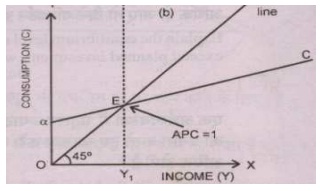
Consumption curve
Illustrate a point on consumption curve at which APC = 1. Answer: APC = C/Y = 1 is possible when C = Y, that is, Consumption is equivalent to Income.
Illustrate a point on consumption curve at which APC = 1.
Answer:
APC = C/Y = 1 is possible when C = Y, that is, Consumption is equivalent to Income.
Explain the main features of Harrod - Domar Growth model. How does the Harrod Domar model explain the occurrence of trade cycles?
The founder of utilitarianism be: (1) Adam Smith. (2) John Stuart Mill. (3) Jeremy Bentham. (4) Feodor Dostoyevsky. (5) Thorstein Veblen. (6) Alfred Marshall. Can someone help me in getting through this problem.
The basic determinant of the transactions demand for money is the
If the MPC is .70 and investment increases by $3 billion, the equilibrium GDP will:
Assume that you receive $18 worth of “jollies” (that is, satisfaction, utility or pleasure) from the very first hole of golf played on a particular day, and that your extra jollies from succeeding holes drops $1 for each and every hole played. You should p
Examples of command economies are: a) the United States and Japan b) Sweden and Norway c) Mexico and Brazil d) Cuba and North Korea
For every value of real GDP, actual investment equals? A. Planned Investments B. The difference between planned investments and actual saving. C. The difference between planned saving and actual saving. D. Planned Saving
What must be added to NNPMP to obtain net national disposable income? Answer: The Net current transfers from abroad must be added to NNPMP to get national disposabl
Illustrate a point on consumption curve at which APC = 1. Answer: APC = C/Y = 1 is possible when C = Y, that is, Consumption is
Suppose the value of exports of goods of a country is Rs. 1,000 crores and the value of imports of goods is Rs. 1,200 crores, what will be the trade balance (or balance of trade)?
18,76,764
1946907 Asked
3,689
Active Tutors
1416479
Questions Answered
Start Excelling in your courses, Ask an Expert and get answers for your homework and assignments!!