--%>

Constant cost industry of production function and costs

When Del’s production function and costs are characteristic for wheat farmers and when wheat farming is a constant cost industry, in that case in the long run, there the price of wheat will be: (i) $4 per bushel. (ii) $6 per bushel. (iii) $8 per bushel. (iv) $10 per bushel. (v) $12 per bushel.
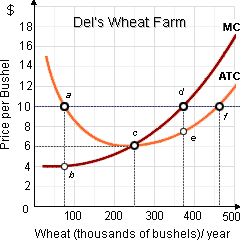
1724_Price Taking and the Price Elasticity.png

Can anybody suggest me the proper explanation for given problem regarding Economics generally?

   Related Questions in Microeconomics

  • Q : Reducing proportion of the work force

    The assertion which unions are more powerful nowadays than ever before is: (i) Supported by the consequences of the union contracts on an inflationary spirals. (ii) Reflected in the growing proportion of workers included in violent, protracted and costly strikes. (iii

  • Q : Demand curve for software upgradation

    Microsoft charges a substantially lower price for a software upgrade than for the initial purchase of the software. This implies that Microsoft views the demand curve for the software upgrade to be: A) more elastic than the demand for the original software. B) upslop

  • Q : Example of bilateral monopoly The most

    The most excellent example of bilateral monopoly from the given list would be the condition of negotiations among: (i) U.S. Immigration Service and undocumented workers from Mexico. (ii) Fast food franchises and workers who are high-school dropouts. (

  • Q : Minimum possible economic losses Hello

    Hello guys I want your advice. Please recommend some views for below illustrated figure of Economics problem that for this profit-maximizing pure competitor, area Pbgh signifies: (1) fixed cost (TFC). (2) average fixed cost (AFC). (3)

  • Q : Neoclassical economics One of my

    One of my friends can't find the answer of this question .Give me answer of this question. How are economic theories created in neoclassical economics?

  • Q : Profits and losses in long run In the

    In the long run: (i) purely competitive firms make zero economic profits. (ii) monopolistically competitive firms make zero economic profits. (iii) effective barriers to entry may permit economic profits. (iv) oligopolists and monopolists may realize

  • Q : Increase in demand for Normal Goods

    Zelda’s purchases of bigger and more cubic zirconium rings since she got a big pay raise are an illustration of a/an: (i) Raise in demand. (ii) Raise in quantity demanded. (iii) Raise in supply. (iv) Deterioration of the tastes.

    Q : Operating the economy of production

    I have a problem in economics on the topic of Production. Please help me in the following question. The economy operating on its production possibilities frontier is as: (1) At full employment. (2) Technologically proficient. (3) Maximizing the output

  • Q : Determine the equilibrium prises When

    When both sellers and potential buyers suppose prices for rider lawn mowers to raise as summer approaches, in that case throughout March and April (in the short run), the equilibrium: (w) price falls but quantity changes are ambiguous. (x) price rises

  • Q : Problem on monoplists Suppose that the

    Suppose that the total cost curve for a monopolist is provided by TC = 3y2 + 800 and its marginal cost curve is given as MC = 6y.  Also assume it faces a market demand curve of py = 280 - 4y and marginal revenue curve of MR = 280 – 8y.