--%>

Compute Gini Index

The areas illustrates in this Lorenz diagram can be used to compute a Gini index as: (i) (cow + pig)/cow. (ii) cow2/(cow + pig).  (iii) pig2/(cow + pig). (iv) cow/(cow + pig) (v) (cow + horse)/pig.
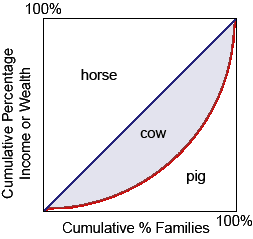
997_Lorenz Curve Problem.png

Can anybody suggest me the proper explanation for given problem regarding Economics generally?

   Related Questions in Microeconomics

  • Q : Are you being charged too much for

    This exercise inspects the higher prices charged in UK for music downloads as compared to the rest of Europe.

  • Q : Labor Contracts-Shop Agreements From

    From the point of view of management, the favored union membership ranking (most favored to the least favored) would be: (i) Closed shop, union shop, agency shop and open shop. (ii) Open shop, agency shop, union shop and closed shop. (iii) Agency shop, open shop, clos

  • Q : Conscious interdependence of oligopoly

    Firms that should contemplate the potential reactions of rival firms while adjusting their pricing and output to maximize long run profit are operating within an industry which is: (1) perfectly competitive. (2) purely competitive. (3) monopolisticall

  • Q : Revenue added via selling an additional

    The revenue added through selling an additional unit of output is: (w) demand elasticity. (x) average profit rate. (y) supply elasticity. (z) marginal revenue. How can I solve my Economics problem?

  • Q : Definition of monopsonist The

    The individual or firm which is the sole buyer of the specific good or resource is a/an: (i) Monopolist. (ii) Oligopolist. (iii) Monopsonist. (iv) Monopolistic competitor. Find out the right answer from the above options.

  • Q : Entry-exit in Long-run equilibrium of

    A competitive industry is in long-run equilibrium only after: (w) net pressure for entry or exit is zero. (x) each firm produces to its capacity. (y) owners reap all the profits they desire. (z) union bosses and firm managers reach mutual agreements.<

  • Q : Aggregate Supplies of Labor The

    The Supplies of labor from a specified population mainly depend on the: (1) Structure of wage rates. (2) Labor force participation rates of different population sub-groups. (3) Individual preferences for the work and income versus the leisure. (4) Levels of investment

  • Q : Immunity of Corporate giants in market

    Can someone help me in finding out the most precise answer from the given options. The Corporate giants are not immune to the market pressures since: (i) They experience the diseconomies of scale. (ii) Advertising decreases the barriers to entry. (iii) Profits give an

  • Q : Monopsonistic exploitation of many

    NCAA rules the forbidding standard employment negotiations among colleges and amateur athletes tend to outcome in: (i) Monopsonistic exploitation of numerous athletes. (ii) Incentives for the collusion among individual college coaches and individual owners of the prof

  • Q : Demand prices exceeds supply prices

    When only Q0 papayas reached the market in that case: (1) desperate buyers would be willing to pay only P1 per papaya. (2) production costs would exceed P2 per papaya. (3) buyers would be indifferent regarding getting additional papaya