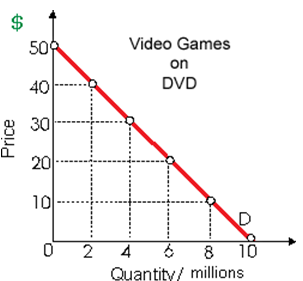
Computations of price elasticity of demand
The price elasticity of demand in given figure below for DVD games among prices of $30 and $40 is roughly: (w) 3/7. (x) 7/3. (y) 1/21. (z) 21. How can I solve my economics problem? Please suggest me the correct answer.
The price elasticity of demand in given figure below for DVD games among prices of $30 and $40 is roughly: (w) 3/7. (x) 7/3. (y) 1/21. (z) 21.
How can I solve my economics problem? Please suggest me the correct answer.
Marginal rate of transformation: This is the amount of one good which should be given to generate one additional unit of a second good. This is also termed as marginal opportunity cost.
Monopolistic competitors generate levels of output which are: (w) more than socially optimal and equitable. (x) economically efficient. (y) where marginal social benefits exceed marginal social costs. (z) certain to generate economic profits.
Significant influences on union non-union wage differentials comprise the: (1) Proportion of an industry which is unionized and the frequency of strikes. (2) Frequency of strikes, inflation and the collective bargaining policies. (3) Collective bargai
Can someone help me in finding out the right answer from the given options. Both level of employment through a firm and the average rate of monopsonistic exploitation of labor are raised when a firm is capable to: (1) Outsource through hiring less productive workers i
What is involuntary unemployment: The people who are willing to work at given wage rate do not obtain work.
Describe the relation between average revenue and marginal revenue. whenever a firm can sell an extra unit or a good by lowering price.
Unlike a firm within purely competitive long run equilibrium, within the long run, there a monopolistically competitive firm which does not price discriminate: (w) produces where P = MC. (y) does not price at the bott
Consequences of the price floor: The consequences of price floor might be: (A) Surplus of the commodity (B) The government might resort to buffer stocks to absorb the excess in the market at the support price and sells the products to consumers beneat
The imposition of rent controls below equilibrium rental rates tends to create: (i) a housing surplus. (ii) booms of new apartment construction. (iii) declines in the quantity and upkeep of rental units. (iv) rising incomes for landlords. (v) enhanced
I have a problem in economics on Profit Maximization in the Labor Markets. Please help me in the following question. All the profit maximizing firms will hire labor up to a point where: (1) MRP = MFC. (2) MRP = w. (3) VMP = w. (4) VMP = MFC.
18,76,764
1942780 Asked
3,689
Active Tutors
1461419
Questions Answered
Start Excelling in your courses, Ask an Expert and get answers for your homework and assignments!!