--%>

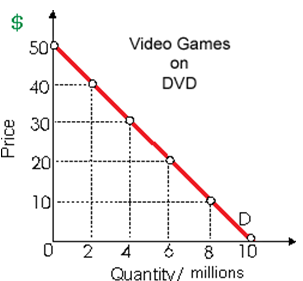
Completely elastic price of demand

On such demand curve, the demand for DVD games is completely elastic at a price of: (w) $50. (x) $25. (y) $20. (z) None of the above.
1382_demand curve for DVD.png

I need a good answer on the topic of Economic problems. Please give me your suggestion for the same by using above options.

   Related Questions in Microeconomics

  • Q : Operation in the short run of fixed

    The curves demonstrated in this figure reflect that: (i) operation in the short run since fixed costs can be measured in the graph. (ii) a disequilibrium that will force some competitors to exit this market. (iii) how firms innovate new technologies in response to pro

  • Q : Maximizing utility from consumption of

    Given that a MU of French fries of 35 utils and a MU for serving of potato chips at 25 utils, when their respective prices are $1.50 and $.80, the person who wants to maximize utility from the consumption of both of such goods would consume: (i) The similar amount of

  • Q : Economies of scale in natural monopoly

    Economies of scale which are substantial relative to market demand result within the market evolving to a: (w) contestable market. (x) collusive oligopoly. (y) natural monopoly. (z) "high tech" industry.

    Q : Define break-even price Break-even

    Break-even price: This is the price at which firms form zero normal profit.

  • Q : Resource of supply curve The resource

    The resource probably to conform to the supply curve demonstrated in this figure would be: (1) housing. (2) capital. (3) labor. (4) land. (5) entrepreneurship.

    Q : Featherbedding in its hiring practices

    The summation of monopolistic exploitation across all the workers tends to raise however a firm as well operates at a more socially and economically proficient level of output and employment whenever the firm is capable to engage in: (1) Blacklisting in its dealings t

  • Q : Standard of Income Distribution

    According to the requirements standard of income distribution: (w) marginal productivity is easily measured. (x) people’s needs are proportional to their marginal products. (y) income must be distributed in proportion to people’s needs. (z

  • Q : Capital to Labor Ratio When the

    When the capital-to-labor (K/L) ratio raises: (1) capital becomes more productive. (2) the interest payments to capital will raise. (3) the wages to labor will probably reduce. (4) labor productivity should rise. (5) the price of capital increases.

  • Q : State the relationship between MPC and

    State the relationship between MPC and multiplier? Answer: The value of multiplier differs directly with MPC.  K=1/1 - MPC.

  • Q : Public utilities in natural monopoly

    Public utilities are generally: (1) regulated natural monopolies. (2) competitive non-profit corporations. (3) consequences of diseconomies of scale in production. (4) only subject to laissez-faire regulation. (5) operated by the federal government.