--%>

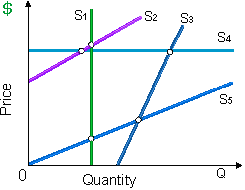
Comparison between supply curves

Comparing supply curves S2 and S3, supply is: (w) more price elastic along S2 than along S3. (x) more price elastic along S3 than S2. (y) equally elastic along both when they have similar slope. (z) unitarily elastic beside S3, and perfectly elastic along S2.
1385_Price Elasticity of Supply1.png

Hello guys I want your advice. Please recommend some views for above Economics problems.

   Related Questions in Microeconomics

  • Q : Market Power-Monopsony Power-Demand for

    Can someone please help me in finding out the accurate answer from the following question. Siberian Software vends custom programs to multinational corporations. Its programs are coded in a remote region. In equilibrium, the Siberi

  • Q : Equilibrium rate of monopsony

    I have a problem in economics on Equilibrium rate of monopsony exploitation. Please help me in the following question. Equilibrium rate of the monopsony exploitation by a firm is a difference between: (i) MRP and VMP. (ii) VMP and w. (iii) MFC and w.

  • Q : Problem on quantity of Whopper Slushees

    When Adam Smith’s invisible hand executed with no government intervention, this market would be in equilibrium and quantity of Whopper Slushees demanded the quantity supplied would be equivalent at: (i) Price P1. (ii) Quantity Q1. (iii) Price P3. (iv) Quantity Q

  • Q : Supply curve of a purely competitive

    A purely competitive firm has a supply curve which is: (w) perfectly elastic. (x) relatively inelastic. (y) flatter than its demand curve. (z) upward sloping as output increases. Hello guys I want

  • Q : Reform or revision of the welfare system

    The most important reform / revision of the welfare system within the past half century occurred throughout the administration of President as: (1) Richard Nixon [1971]. (2) Jimmy Carter [1978]. (3) Ronald Reagan [1984]. (4) Bill Clinton [1996]. (5) G

  • Q : Classified industries as oligopolistic

    Industries which would be classified as oligopolistic comprise: (w) public utilities. (x) postal service. (y) breakfast cereal. (z) retailing. Hello guys I want your advice. Please recommend some views for above

  • Q : High relative income define by Census

    The Department of the Census defines high relative income as experienced while families: (w) earn more than $60,000 annually per worker in the family. (x) have income which is twice the median incomes of other American families. (y) e

  • Q : Investment in Equilibrium Investment is

    Investment is within equilibrium in all of the given cases EXCEPT while: (w) after adjusting for risk, maturity, and liquidity, all income producing assets yield identical returns. (x) all prices of assets exactly equal their respecti

  • Q : Economic project Hello, Would you

    Hello, Would you please find a project in managerial economic in the attachment. Please tell me in which price you will be solve it and when you complete it? NOTE: I attach tow files (one is the project and another as the sample for it) I choose Starbucks company for the project. A Special N

  • Q : Public utilities in natural monopoly

    Public utilities are generally: (1) regulated natural monopolies. (2) competitive non-profit corporations. (3) consequences of diseconomies of scale in production. (4) only subject to laissez-faire regulation. (5) operated by the federal government.