--%>

Charging price in short run for profit maximizing

Now Roast chicken dinners replace fried chicken in popularity in this given demonstrated figure. In the short run that profit maximizing firm will charge a price equal to: (w) $12.00. (x) $11.00. (y) $10.00. (y) $9.00. (z) $6.50.
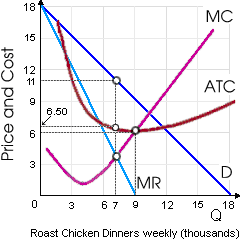
2063_Market Power and Short Run Economic Profit.png

Hello guys I want your advice. Please recommend some views for above Economics problems.

   Related Questions in Microeconomics

  • Q : Type of model used by economists Which

    Which type of model is used by the economists to analyze competitive market?

  • Q : Profit Maximization-total proceeds and

    The entire profit maximizing organization will hire more labor up to the point where: (w) Average physical product of labor equivalents the nominal wage. (x) Last unit of labor adds uniformly to net revenue and net cost. (y) Marginal product of the labor is at its hig

  • Q : Determine the market price when demand

    When both demand and supply rise within the market for cell phones, we would suppose the market price to: (w) increase. (x) decrease. (y) increase, decrease, or stay similar, depending upon the relative magnitudes of the shifts. (z) s

  • Q : Marginal tax rate on earn income The

    The marginal tax rate onto earned income in the negative income tax system demonstrated in this figure is: (1) 15 percent. (2) 20 percent. (3) 25 percent. (4) 33.3 percent. (5) 50 percent.

  • Q : Price elasticity coefficient at

    Every point beside a vertical demand curve (when there was such a thing) would include a price elasticity coefficient equivalent to: (1) 1. (2)  1. (3) zero. (4) infinity. (5)  1/2. Hey friends please giv

  • Q : Monopolistic competition and product

    The demand curve facing a monopolistically competitive firm might shift rightward when this: (w) increases wages to workers. (x) experiences a decline in costs. (y) advertises successfully. (z) responds strategically to competitors&rs

  • Q : Labor Supply Curves to the Competitive

    The price taker in labor market: (1) Can set the salary that it will pay for the labor it hires. (2) Can set the salary at which it supplies the use of its labor. (3) Doesn’t care what salary it pays or obtains. (4) Can’t influence the wage recognized by t

  • Q : Tax in long run relatively inelastic

    You daily buy author-published books of poetry that are relatively inelastically supplied within the long run. Then government imposes a tax upon books of poetry. Then tax is probable to be borne primarily through: (1) retail book stores. (2) consumer

  • Q : Purely and monopolistically competitive

    Purely competitive markets and monopolistically competitive markets have in general: (1) the collusive tendencies of large rival firms. (2) extensive negotiations about prices among buyers and sellers. (3) freedom of entry and exit wi

  • Q : Monopsonistic exploitation-labor union

    The labor union contracts, a comparable worth rule, or minimum salary laws might boost up equilibrium employment when a firm has been practicing: (i) Price discrimination. (ii) Monopolistic exploitation. (iii) Feather-bedding. (iv) Blacklisting. (v) Monopsonistic expl