--%>

Changes in equilibrium GDP caused by government

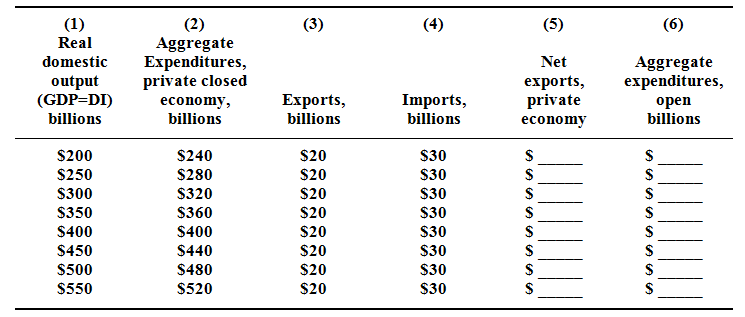
Refer to columns 1 and columns 6 of the tabular data described below. Suppose that all taxes are personal taxes and that government spending does not induce a shift in the private aggregate expenditures schedule. Calculate and describe the changes in equilibrium GDP caused by the addition of government.
 

2365_Incorporate government.png

E

Expert

Verified

The addition of $20 billion of government expenditures and $20 billion of personal taxes raise equilibrium GDP from $350 to $370 billion. The $20 billion rise in G raises equilibrium GDP through $100 billion (= $20 billion x the multiplier of 5); the $20 billion rise in T drop consumption by $16 billion at every level. (= $20 billion x the MPC of .8). This $16 billion decline in turn decreases equilibrium GDP by $80 billion ($16 billion x multiplier of 5).  The overall change from comprising balanced government spending and taxes is $20 billion (= $100 billion - $80 billion).

   Related Questions in Finance Basics

  • Q : Multiplier effect Normal 0 false false

    Normal 0 false false

  • Q : Define Workload Workload : The

    Workload: The measurement of rises and reduces of inputs or demands for work, and an ordinary basis for projecting related budget requires for both established and new programs. This approach to BCPs is frequently viewed as an alternative to outcome o

  • Q : Define the term Surplus Define the term

    Define the term Surplus: It is an outdated term for a fund’s excess of assets (or resources) over liabilities.

  • Q : Define Tort Tort : It is a civil wrong,

    Tort: It is a civil wrong, other than a breach of contract, for which the court awards indemnity. The traditional torts comprise malpractice, negligence, assault and battery. Lately, torts have been widely expanded such that the interference with a co

  • Q : Explain Fund Condition Statement Fund

    Fund Condition Statement: A budget display, comprised in the Governor’s Budget, shortening the operations of a fund for the past, present, and budget years. The display comprises the starting balance, previous year adjustments, loans, revenue, t

  • Q : What is the Character of Expenditure

    Character of Expenditure: A classification recognizing the major purpose of expenditure, like State Operations, Local Assistance, Capital Outlay, or Unclassified.

  • Q : Absolute and relative sizes of the

    Normal 0 false false

  • Q : Describe Schedule 10 Schedule 10 :

    Schedule 10: (Supplementary Schedule of Appropriations): The Department of Finance control document listing all the appropriations and allocations of funds accessible for expenditure throughout the past, present, and budget years. Such documents are s

  • Q : What is Capital Outlay Capital Outlay

    Capital Outlay (CO): A character of expenses of funds to obtain land, plan and build new buildings, expand or transform existing buildings, and/or purchase tools associated to such construction.

  • Q : Finance powerpoint Hi, I am a

    Hi, I am a management student studying in a business school. I have given a case study (attached below in PDF) as evaluation. I was able to get an English version but since i am not familiar with the subject i don't know how to solve this. I would like to know if you can provide any solution f