--%>

Case study of harvesting a tree

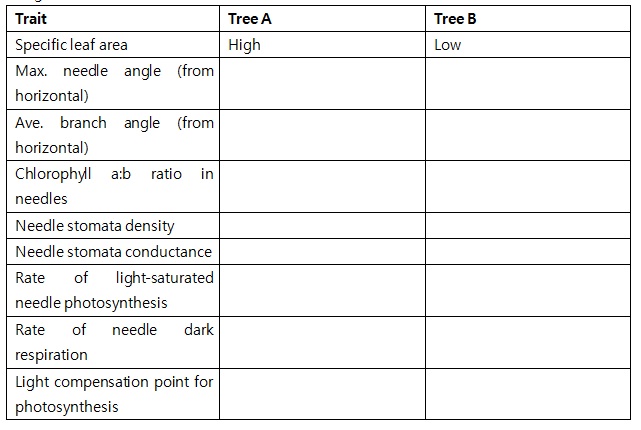
Recently, a friend accused her neighbor of harvesting a tree (sapling of balsam fir, Abies balsamea) from her land without permission. Her neighbor claims that he bought it from a Christmas tree plantation (growing in a clearing down the road).  Your friend says the tree was harvested from the understory of her mixed conifer-hardwood forest (although she can’t locate the cut stump). In order to help determine the guilt or innocence of the accused, you compare the physiological and morphological traits of his tree with those of an open-grown tree from the plantation down the road.  Based solely on the leaf morphology data in the table, which tree (A or B) most likely grew in your friend’s understory? (Assume that the soil was similar in both places.) Based on your answer and information you find in the literature, provide a qualitative guess regarding differences between Tree A and Tree B in the remaining traits.  Specifically, for each tree, insert “high” or “low” for each trait. 
227_case study.jpg

   Related Questions in Financial Accounting

  • Q : Canadian Outdooring Explain Canadian

    Explain Canadian Outdooring in brief ?

  • Q : Commercial bank problems Select the

    Select the right answer of the question. Assume that, for every 1-percentage point decline of the discount rate, commercial banks collectively borrow an additional $2 billion from Federal Reserve banks. Also suppose that reserve ratio is 20 percent. If the Fed incre

  • Q : Uncertainty of exchange rate

    Uncertainty of the exchange rate does not essentially means that the firms face exchange risk exposure. Explain this scenario.

  • Q : What is Casting What is Casting in

    What is Casting in Accounting. What is its significance?

  • Q : Advantages and disadvantages of gold

    Write the advantages and disadvantages of the gold standard.

  • Q : Define the term Equipment Define the

    Define the term Equipment in Accountancy? Why they are used?

  • Q : Monetary approach to determine exchange

    Derive and explain monetary approach in order to determine the exchange rate.

  • Q : Define Revenue Revenue : The amount

    Revenue: The amount (sum) of money which a company really receives throughout a specific period, comprising discounts and deductions for the returned merchandise. This is the "top line" or "annual income" figure from which costs are subtracted to find

  • Q : Increase the return without any

    Suppose that treasurer of IBM has an extra cash reserve of $1,000,000 to invest for the six months. Six-month interest rate is 8% per annum in U.S. and 6% per annum in the Germany. Presently, spot exchange rate is DM1.60 per dollar and six-month forward exchange rate

  • Q : Avoidable Interest The book says

    The book says "avoidable interest is the amount of interest cost during the period that a company could theoretically avoid if it had not made expenditures for the asset." This makes it sound like avoidable interest is the total amount of interest paid for an asset. I know it's not but I was wonder