--%>

Case of fuel efficient machinery in market adjustment

If the soybean market begins in equilibrium on S0D0, and in that case farm machinery becomes more fuel efficient, the market changes to: (1) S0D1. (2) S1D2. (3) S1D0. (4) S2D1. (5) S0D2.
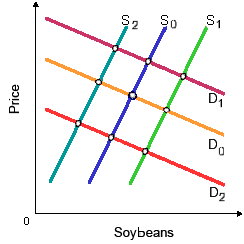
637_soybean market in equilibrium.png

Please choose the right answer from above...I want your suggestion for the same.

   Related Questions in Public Economics

  • Q : Where is economic efficiency for

    Economic efficiency for society does not need that such: (w) the greatest possible satisfaction is enjoyed through all consumers specified their individual budgets. (x) maximum possible value of output from obtainable resources. (y) exact goods are us

  • Q : Comparative Systems-Socialism I have a

    I have a problem in economics on Comparative Systems- Socialism. Please help me in the following question. From roughly 1890 till year1990 or thus, the main challenger of capitalism was: (1) Monarchy. (2) Fascism. (3) Socialism. (4) Anarchism.

  • Q : Weather ruins crop-equilibrium

    When the soybean market is firstly in equilibrium on S0D0 and in that case severe weather ruins much of the crop, then the market moves to: (1) S1D0. (2) S1D2. (3) S2D0<

  • Q : Reason of confronting problem of

    People whole the world confront the problem of scarcity at all times just because which one reason: (i) Greedy capitalist monopolies under-produce goods, (ii) International markets are plagued with flawed distribution, (iii) Restricted resources and t

  • Q : Validation of a new theory in

    A new theory evolves within common sense only after this is determined: (1) Helpful through extensive testing. (2) Within conformity along with Newtonian mechanics and Occam's razor. (3) To contain relatively only some exceptions. (4) Acceptable through the Institute

  • Q : Hedonistic calculus–regulation of human

    Social welfare is exploited while a “hedonistic calculus” regulates all human action as per the interventionist “liberal”: (i) John Stuart Mill. (ii) Thorstein Veblen. (iii) Milton Friedman. (iv) Karl Marx. (v)

  • Q : Explain about the Opportunity Cost in

    Opportunity cost is explained as the value of the: (w) best alternative specified for the decision made. (x) sum of all alternative choices while a decision is made. (y) monetary cost of making a decision. (z) cost incurred while one ignores alternati

  • Q : Explain about the Economic Scarcity

    Economic scarcity: (w) will eventually be removed by technological progress. (x) is synonymous along with an economic shortage. (y) cannot exist within a market economy. (z) will exist as long as human needs exceed the goods we can produce using our r

  • Q : Administrative estimations of peoples

    The requirement criterion of distribution usually entails: (1) Greater production incentives than the other systems. (2) Much difficult administrative estimations of people's requirements. (3) Generation of extreme pollution. (4) Dividing national inc

  • Q : Perceptions about equity and need

    Government often bases decisions regarding distributions of income and output on: (i) unemployment and Inflation. (ii) Positive economic theories. (iii) Perceptions regarding equity and need. (iv) Market demands and supplies. Can s