--%>

CAPM-Project Evaluation and Risk Adjustment

UCD Vet Products – a hypothetical publicly traded corporation (UCDV) — is considering investing in a new line of equine DNA analysis technology for race horse breeders. The project will yield the net cash flows listed in the table below. Assume that this project is as risky as UCDV’s stock and suppose that the risk free rate is 1% per year, the expected market return is 8%, and UCDV’s beta is 0.55.

What is the net present value of expansion project? Should UCDV undertake the project? How would your answer change if UCDV’s beta were 1.5 rather?
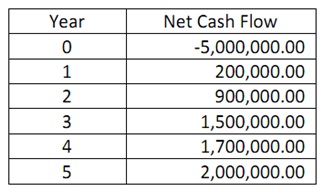
1602_capm risk.jpg

   Related Questions in Corporate Finance

  • Q : How could we project exchange rates How

    How could we project exchange rates within order to be capable to forecast exchange differences?

  • Q : Expected return and standard deviation

    If an investor is considered to be risk-averse, what is his/her attitude towards expected return and standard deviation?

  • Q : Explain definition of put–call parity

    Explain the definition of put–call parity described by Reinach.

  • Q : Using the DCF method Your Corp, Inc.'s

    Your Corp, Inc.'s data is as follows:Beta; 1.30Recent dividend; $.90Expected dividend growth; 7%Expected return of the market; 14%Treasury Bills are yielding; 4%Most recent stock price; $65 A] Us

  • Q : Problem on exponential growth rate

    Atlanta Company stock is predicted to follow an exponential growth rate. The relationship among the current stock price P0, future price PT after time T, and continuously compounded rate of the return r, is: PT = P0eγT. The stock doesn’t pay any

  • Q : Strategy of Bear Spread State when

    State when markets are anticipated to go down then what is the Strategy of Bear Spread?

  • Q : Public Finance which type of tax,

    which type of tax, direct or indirect is applicable in underdeveloped countries? Why? Show your critical areas and weaknesses.

  • Q : Shall we use the arithmetic mean or the

    The market risk premium is the difference between the historical return on the stock market and the return on bonds. But how many years does “historical” imply? Shall we use the arithmetic mean or the geometric one?

  • Q : Sinking Fund problem Berks Corporation

    Berks Corporation is expecting to have EBIT next year of $12 million, with a standard deviation of $6 million. Berks have $30 million in bonds with coupon of 10%, selling at par, which are being retired at the rate of $2 million annually. Berks also have 100,000 share

  • Q : Liquidity Ratios Liquidity Ratios :

    Liquidity Ratios: Such ratios comprise the Current Ratio and the Quick Ratio or the acid test ratio. Liquidity ratios demonstrate the Liquid position of a company in the short term that is the capability of a firm to pay its obligations in short term.