--%>

Capital Market in Private Economy

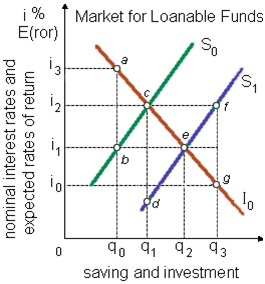
This capital market is within this illustrated figure a closed private economy. The first plans of savers and investors are demonstrated as curves S0 and I0. There market equilibrium will exist at: (1) point a. (2) point b. (3) point c. (4) point d. (5) point e.
28_Problem on Capital Markets.png

Can anybody suggest me the proper explanation for given problem regarding Economics generally?

   Related Questions in Microeconomics

  • Q : Structure-conduct-performance From

    From roughly 1890 till 1970 year, the “structure-conduct-performance paradigm” controlled theories regarding how firms behave in various types of markets. The term “structure” in this expression refers to such

  • Q : Total variable cost Total variable cost

    Total variable cost:1. variable cost changes with the change in quantity. It increase or decrease as the output change.2. it is zero when output is zero3. Its curve is parallel to the curve of total cost.4. Example :- cost of r

  • Q : Labor markets gain maximization When,

    When, after hiring the very last worker, the organization’s profit is similar as it was before the last worker was hired, then the firm must: (p) Hire more workers to raise the profit. (q) Layoff some workers to raise the profit. (r) Not appoint any more workers

  • Q : Equality between marginal revenue and

    If all variable costs can be covered, in that case every firm maximizes profit by adjusting output till: (w) total revenue is maximized. (x) marginal revenue = average cost. (y) average cost = marginal cost. (z) marginal revenue = marginal cost.

  • Q : Hicks Model of Collective Bargaining I

    I have a problem in economics on Hicks Model of Collective Bargaining. Please help me in the following question. The period of union strikes and the equilibrium wage rate at conclusion of a strike are the focus of: (i) Taft-Hartley Act of 1948. (ii) B

  • Q : Elimination of featherbedding Can

    Can someone help me in finding out the right answer from the given options. The labor union goals for members don’t usually comprise: (i) Higher wages. (ii) Better working conditions. (iii) Bigger fringe advantages. (iv) Elimination of feather-bedding.

  • Q : Demand curves of monopolistic

    Monopolistic competitive firms face: (w) perfectly elastic demand curves. (x) perfectly inelastic demand curves. (y) downward sloping demand curves. (z) the industry demand curves. Hello guys I want your advice. Pl

  • Q : Charging price by long run operating

    Most monopolists whom continue to operate in the long run are capable to charge a price as: (w) greater than minimum average total costs [ATC]. (x) less than MR. (y) less than marginal costs [MC]. (z) less than which of a pure competitor along with si

  • Q : Words of Frank Knight In words of Frank

    In words of Frank Knight, risk, not like uncertainty: (w) is totally unpredictable. (x) is a main source of pure economic profits. (y) may be estimated. (z) cannot be taken into account while firms make decisions regarding production and pricing.

  • Q : Zero economic profits in long-run

    In long-run equilibrium, a monopolistically competitive firm is making: (a) economic profits. (b) zero economic profits. (c) negative economic profits. (d) revenues that exceed total costs. Can anybody suggest me t