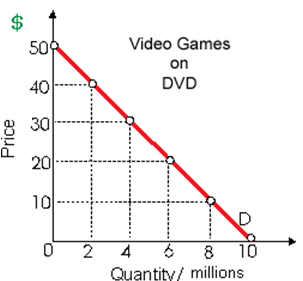
Calculations of price elasticity of demand
At a price of $50, the demand for DVD games is roughly: (w) perfectly elastic. (x) perfectly inelastic. (y) unitarily elastic. (z) relatively inelastic. Please choose the right answer from above...I want your suggestion for the same.
At a price of $50, the demand for DVD games is roughly: (w) perfectly elastic. (x) perfectly inelastic. (y) unitarily elastic. (z) relatively inelastic.
Please choose the right answer from above...I want your suggestion for the same.
When the price of a good or resource drops, the demands for: (i) That good or resource raise. (ii) Complementary goods or resources reduce. (iii) Substitute goods or resources reduce. (iv) Luxury goods and inferior resources drop.
I have a problem in economics on Centers for production in circular flow model. Please help me in the following question. The centers for production in a circular flow model are termed as: (1) Households. (2) Public enterprises. (3) Business firms. (4
Can someone help me in finding out the right answer from the given options. The monopsonist in labor market faces a: (1) Totally elastic demand for labor. (2) Completely elastic supply of the labor. (3) Completely inelastic supply of the labor. (4) Positively sloped l
The slope of the ray by the origin which is tangent to point b equivalents to: (w) the reciprocal of the price elasticity of demand. (x) P / Q. (y) 0a / 0c. (z) the price elasticity of supply. Q : High economic profits High economic High economic profits for firms are least probable to arise by: (1) important market power. (2) “cut-throat” competitive pricing policies. (3) superior products. (4) unusually efficient managers. (5) price-maker behavior. Q : Average cost of producing level of When the hourly wage rate (w) of $15 and the hourly price of capital (r) of $75, the average cost of producing any specified level of output into the long run will be minimized where: (1) MPPL = MPPK. (2) MPPL/MPPK =
High economic profits for firms are least probable to arise by: (1) important market power. (2) “cut-throat” competitive pricing policies. (3) superior products. (4) unusually efficient managers. (5) price-maker behavior. Q : Average cost of producing level of When the hourly wage rate (w) of $15 and the hourly price of capital (r) of $75, the average cost of producing any specified level of output into the long run will be minimized where: (1) MPPL = MPPK. (2) MPPL/MPPK =
When the hourly wage rate (w) of $15 and the hourly price of capital (r) of $75, the average cost of producing any specified level of output into the long run will be minimized where: (1) MPPL = MPPK. (2) MPPL/MPPK =
Profit maximization within the long run does not need a firm to: (i) produce in accord along with the law of equal marginal advantage. (ii) adjust the resource mix till MPPL/w = MPPK/r. (iii) minimize cost for its selected level of output. (iv) produc
The fundamental economic question probably to generate answers heavily based into debatable value judgments is: (1) what goods will society produce? (2) how will resources be used to yield the goods society chooses to produce? (3) to whom will the goo
Can someone please help me in finding out the accurate answer from the following question. The profit-maximizing competitive firm hiring from the competitive labor market will be in balance or equilibrium where: (i) w = MRC. (ii) MPP = MRC. (iii) VMP = MPP. (iv) VMP =
The present value of an annual income stream which goes onto forever is: (w) infinite. (x) zero. (y) the annual income multiplied through the interest rate. (z) the annual income divided through the interest rate.
18,76,764
1935098 Asked
3,689
Active Tutors
1444380
Questions Answered
Start Excelling in your courses, Ask an Expert and get answers for your homework and assignments!!