--%>

Break-even level of income under negative income tax

For a family of four the break-even level of income under the negative income tax system demonstrated in this figure is: (1) $15,000 per year. (2) $30,000 per year. (3) $45,000 per year. (4) $60,000 per year. (5) $75,000 per year.
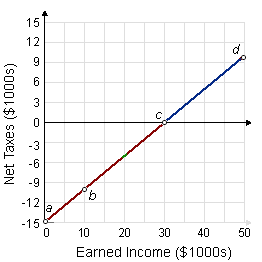
230_Negative Income Tax Problem.png

Hey friends please give your opinion for the problem of Economics that is given above.

   Related Questions in Microeconomics

  • Q : Total revenue by quantity

    If LoCalLoCarbo produces the profit-maximizing quantity and charges the profit-maximizing price, in that case its total revenue equals the area of the rectangle as: (i) 0P2fq4. (ii) bdP4P1. (iii) 0P4dq2

  • Q : Disadvantage of sole proprietorships

    The disadvantage of both sole partnerships and proprietorships is that the: (i) Financial resources are generally more restricted than for a corporation. (ii) Income is subject to the double taxation. (iii) Principal-agent troubles are far less simple

  • Q : Problems on Featherbedding The

    The Contracts needing employment after some worker’s jobs have been made outdated by automation are illustrations of: (1) Labor-reducing protectionism. (2) Featherbedding. (3) Check-off provisions. (4) Yellow dog contracts. (5) Blacklisting.

    Q : Indication of Lorenz Curves The Lorenz

    The Lorenz curve gives an indication of: (w) the poverty rate. (x) dead end poverty. (y) relative poverty. (z) post-transfer poverty. Hello guys I want your advice. Please recommend some views for above Eco

  • Q : Negative externalities Give the answer

    Give the answer of following question. Negative externalities arise: A) when firms pay more than the opportunity cost of resources. B) when the demand curve for a product is located too far to the left. C) when firms "use" resources without being compelled to pay for

  • Q : Floating exchange rates Provide

    Provide solution of this question. In saying that the present system of floating exchange rates is managed we mean that: A) countries which allow their exchange rate to move freely will lose their borrowing privileges with the IMF.  B) the value of any IMF member

  • Q : Facing a demand curve by purely

    A purely competitive firm faces a demand curve which is: (1) perfectly inelastic. (2) upward sloping. (3) perfectly elastic. (4) a vertical line. (5) downward sloping. Can anybody suggest me the proper explanation

  • Q : Isoquants and isocost lines By using

    By using isoquants and isocost lines, illustrates graphically that rise in y will result in a decline in the quantity demanded of x1 and also illustrates that rise in the price of x1 will result in a reduction in the quantity demanded of x1<

  • Q : What is APS What is APS? APS = S/Y. It

    What is APS? APS = S/Y.It is the ratio of income to saving which is termed as APS.

  • Q : Different pure economics rent Pure

    Pure economic rents are different most from economic profits in which they are: (w) received by the owners of productive resources. (x) frequently costs to the firm using the resources which generate them, but not to society as a whol