--%>

Break even and zero economic profit

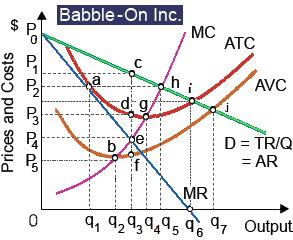
After Babble-On’s patents lapsed and entry and exit turned into possible in this illustrated figure of market, in the long run Babble-On would be expected to: (i) continue to reap economic profits. (ii) break even and experience zero economic profit. (iii) have zero accounting profit. (iv) operate at inefficiently low levels of output. (v) raise the price of its software.
128_Market Power.png

Can someone explain/help me with best solution about problem of Economics...

   Related Questions in Microeconomics

  • Q : Percentage changes in quantity supplied

    The price elasticity of supply can be very approximately computed as the percentage change within: (w) responsiveness of price to variations within the quantity supplied. (x) quantity divided through the intercept coefficient of the supply curve. (y)

  • Q : Jurisdictional Strikes The Taft-Hartley

    The Taft-Hartley Act prohibited strikes against a firm over the issue of which of the two or more competing unions would symbolize the firm’s employees. These strikes are termed as: (i) Jurisdictional strikes. (ii) Strategic representation strikes. (iii) Wildcat

  • Q : Demand and Supply-Production to double

    When Mary usually quaffs three glasses of Lost Horizons Cabernet Sauvignon every day, her demand for her favorite vintage will be least probable affected by: (i) The plague of grape worms ruining the bouquet of Lost Horizons Cabernet (ii) Receiving a $2 an hour pay hi

  • Q : Demand for product when its sales fall

    When a 10% hike in the price of paisley socks causes sales to fall with 20%, the demand for such socks is: (1) perfectly inelastic. (2) relatively inelastic. (3) unitarily elastic. (4) relatively elastic. (5) perfectly elastic. <

  • Q : Normative Economics and Income

    The fundamental economic question probably to generate answers heavily based into debatable value judgments is: (1) what goods will society produce? (2) how will resources be used to yield the goods society chooses to produce? (3) to whom will the goo

  • Q : Competitive equilibration processes

    When a purely competitive industry is within long-run equilibrium and consumer demand then raises, the short-run industry quantity supplied and equilibrium price would tend to: (w) fall. (x) rise. (y) remain similar. (z) swing up and

  • Q : Features of Monopoly Features of

    Features of Monopoly: A) A Single seller B) No close replacement available. C) No freedom for entry of new firms. D) Possibility of price discrimination.

  • Q : Alfred Marshall categorization of

    If Alfred Marshall categorized the analytical periods of time, he supposed that in short run it is: (i) Not possible to vary technology and at least one resource is fixed and hence at least one kind of cost is as well fixed. (ii) Possible to move the resources from on

  • Q : Purely competitive firms in long-run

    Purely competitive firms in long-run equilibrium as: (w) should use the most efficient technology available. (x) follow cut throat policies to produce more than society demands. (y) produce output levels where TC = TR = MR = MC = P = AR = AC. (z) have

  • Q : Hike within the minimum legal wage

    Labor market advises that a hike within the minimum legal wage from $5 per hour to $8 per hour will decrease: (1) the crime rate by 3,000. (2) national unemployment rates. (3) employment among unskilled workers by approximately 1,500 positions. (4) th