--%>

Average retail price and the consumer Price Index

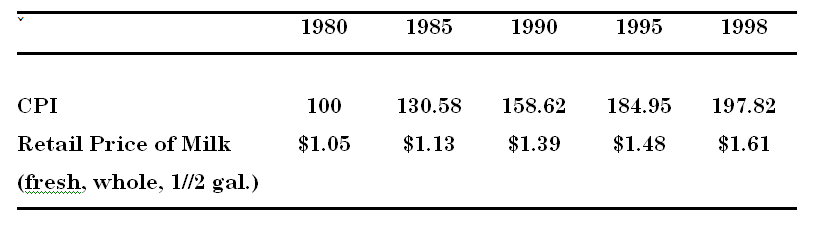
Table illustrates the average retail price of milk and the Consumer Price Index from the year 1980 to 1998.
42_Average retail price and the consumer Price Index.png

Compute the real price of milk in the year 1980 dollars. Has the real price increased/decreased/stayed the similar since the year 1980?
Real price of milk in year X =CPI1980 /CPI year X nominal price in year 1980

                    1980 $1.05        1985 $0.86            1990 $0.88     1995 $0.80  1998 $0.81

Since 1980 the real price of milk has reduced.


   Related Questions in Microeconomics

  • Q : Increase profit of cartel-member A

    A member of a cartel would be probably to increase its profits by: (1) undercutting the prices of other cartel members when this did not get caught. (2) setting its price above which of other cartel members. (3) aggressive nonprice marketing promotion

  • Q : Market price below equilibrium price

    When the market price is beneath the equilibrium price then: (i) The market will clear. (ii) An excess exists. (iii) Consumers will not invest. (iv) The shortage exists. (v) Each and every consumer will be satisfied. Find out the r

  • Q : Maximum economic profits in purely

    For this purely competitive firm, area P2P1de shows: (1) fixed cost (TFC). (2) losses, but the minimum possible economic loss. (3) average fixed cost (AFC). (4) maximum economic profits. (5) the rate of return on investment.

  • Q : Inequality in the distribution of income

    Increased inequality within the distribution of income into the United States since around 1975 is least attributable to: (1) baby boomers becoming adults. (2) a shift from manufacturing to service industries. (3) the rising percentage of households h

  • Q : Cost and revenue assume the firm is a

    assume the firm is a price taker and faces a market price of €60 per unit. draw the AR and MR curves

  • Q : NOT cartelized product in market power

    Products which have NOT been cartelized comprise: (w) oil. (x) bananas. (y) sugar. (z) wheat. Can anybody suggest me the proper explanation for given problem regarding Economics generally?

  • Q : Workers volunteered to work in purely

    Even though workers volunteered to work as "for free", such purely competitive firm would never hire more than: (i) L2 workers. (ii) L3 workers. (iii) L4 workers. (iv) L5 workers. (v) L6 workers.<

  • Q : Practicing joint profit maximization A

    A cartel is: (w) any large multinational corporation like OPEC. (x) a group of oligopolists practicing conscious parallelism of action. (y) a group of firms which practices joint profit maximization. (z) a multinational firm along with government subs

  • Q : Labor Contracts of Check-off Provisions

    When a collective bargaining contract comprises a ‘check-off provision’: (1) Union workers can be fired when they don’t meet the production quotas. (2) Firms gather the union dues through deducting them from the paychecks. (3) Workers are needed to d

  • Q : Profit Maximization-total revenue-total

    The entire profit maximizing organization will hire more labor up to the point where: (i) Average physical product of labor equivalents the nominal wage. (ii) Last unit of labor adds uniformly to net revenue and net cost. (iii) Marginal product of the labor is at its