--%>

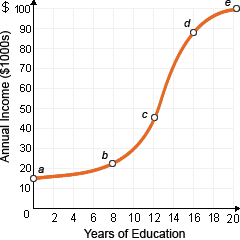
Average rate of return in Human Capital

This illustrated graph indicates that, there on average, rate of return to education is greatest for finishing the previous year of: (1) kindergarten, at point a. (2) grade school, at point b. (3) high school, at point c. (4) undergraduate college, at point d. (5) a professional degree (for example, doctor or lawyer) at point e.
1106_Human Capital problem.png

Can anybody suggest me the proper explanation for given problem regarding Economics generally?

   Related Questions in Managerial Economics

  • Q : Price of output in purely competitive

    When this purely competitive labor market is primarily in equilibrium at D0L, S0L, a moving step to equilibrium at D1L, S0L would be probably to follow from increases in: (w) imports of this good by foreign competitors. (x)

  • Q : Explain the reasons for demand curve

    Explain the reasons for demand curve slopes downward.

  • Q : Substitution effect of wage rate The

    The substitution effect of a small change within the wage rate dominates the income effect for that worker at each wage rate: (w) exceeding $5 per hour. (x) between $5 per hour and $24.99 per hour. (y) exceeding $25.01 per hour. (z) b

  • Q : Average wages for workers Average

    Average female wages are historically beneath the average for male workers due to: (w) concentration in low income occupations. (x) placement in low status job positions. (y) lower admission in professional schools and skilled trades.

  • Q : More productive firm for labor Workers

    Workers who keep their jobs will be more productive after firms adjust to raises in: (1) competition in an industry. (2) wages. (3) technological advances. (4) capital costs. (5) government regulation. Hey friends please give your

  • Q : Recession - Phases of business cycle

    Describe about the term Boom in phases of business cycle.

  • Q : Wage rate and price of leisure

    Increases within the wage rate all the time: (w) lack impact on the relative price of leisure. (x) increase the relative price of leisure. (y) decrease the relative price of leisure. (z) increase the quantity of individual labor supplies.

  • Q : Less elastic demand for a resource At

    At any price of, the demand for a resource is fewer elastic the: (w) easier this is to substitute other resources for this. (x) harder this is to substitute other resources for this. (y) more elastic the demand for the output this produces. (z) greate

  • Q : Marginal Product of Labor in Firm If

    If this firm maximizes profit, this will be producing under circumstances of: (1) increasing returns to labor. (2) economies of scale. (3) diminishing returns to labor. (4) constant returns to labor. (5) adverse selection and moral hazard.

    Q : Illustrates the case of customary

    Illustrates the case of customary pricing with details?