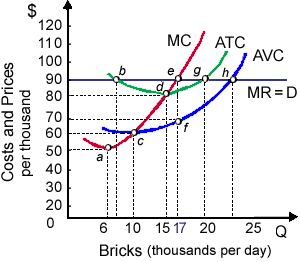
Average of incurring total fixed costs
This brickyard is incurring total fixed costs which average about: (1) $200 daily. (2) $300 daily. (3) $400 daily. (4) $500 daily (5) $600 daily. Can anybody suggest me the proper explanation for given problem regarding Economics generally?
This brickyard is incurring total fixed costs which average about: (1) $200 daily. (2) $300 daily. (3) $400 daily. (4) $500 daily (5) $600 daily.
Can anybody suggest me the proper explanation for given problem regarding Economics generally?
The economic system which depends associatively the least for its effectiveness and overall success on honesty and of members of economically and socially most elite groups in the system are nearly certainly: (1) Oligarchintegrity and hum
Subsequent to adjusting for inflation, Alex Rodriquez salary with NY Yankees was much higher in the year 2006 than Henry Aaron's salary with the Atlanta Braves in the year 1970s that implies that: (i) The 2006 Yankees was more liberal than the year 1970s Braves. (ii)
Which of the following diagrams depictes(s) the effect of an increase in the price of Budweiser beer on the market for Coors beer? A) A and C. B) A only. C) B only. D) C only. Q : Purely competitive firm with no market A purely competitive firm along with no market power faces: (1) a perfectly elastic demand curve. (2) a perfectly elastic supply curve. (3) a perfectly inelastic demand curve. (4) a perfectly inelastic supply curve. (5) a downward sloping demand curve
A purely competitive firm along with no market power faces: (1) a perfectly elastic demand curve. (2) a perfectly elastic supply curve. (3) a perfectly inelastic demand curve. (4) a perfectly inelastic supply curve. (5) a downward sloping demand curve
This monopolistic competitor generates Q0 output where is: (1) MR = MC. (2) MSB > MSC. (3) average cost is not minimized. (4) P = ATC. (5) All of the above. Q : Production utilizing knowledge or I have a problem in economics on Production utilizing knowledge or technology. Please help me in the following question. Production necessitates utilizing knowledge or technology to apply energy to rise the: (i) Amount of resources accessible. (ii) In
I have a problem in economics on Production utilizing knowledge or technology. Please help me in the following question. Production necessitates utilizing knowledge or technology to apply energy to rise the: (i) Amount of resources accessible. (ii) In
Can someone please help me in finding out the accurate answer from the following question. When average production costs reduce as the total production of a firm rises, the firm is experiencing: (i) Economies of the scale. (ii) Economies of scope. (iii) Diseconomies o
Competitive firms determine this difficult to exploit consumers as: (w) consumer boycotts generate bad publicity. (x) market distributions of products are uniformly fair. (y) government price ceilings equivalent opportunity costs. (z) prices that exceed costs attract
The functions of profits into a market economy do NOT comprise: (1) stimulation for firms to be innovative and efficient. (2) compensating savers for delays of consumption. (3) signaling changing business conditions. (4) inducing mimi
Natural barriers to entry would include: (w) long established brand loyalty. (x) enforcement of existing antitrust laws. (y) technology which dictates large plant size. (z) patents and copyright laws. Can anybody s
18,76,764
1939250 Asked
3,689
Active Tutors
1414717
Questions Answered
Start Excelling in your courses, Ask an Expert and get answers for your homework and assignments!!