--%>

Average cost per unit of production

When Prohibition Corporation maximizes profit within its production of St. Valentine’s Day software, there average cost per unit of it produced will be roughly: (i) $4 per copy. (ii) $10 per copy. (iii) $18 per copy. (iv) $24 per copy. (v) $32 per copy.
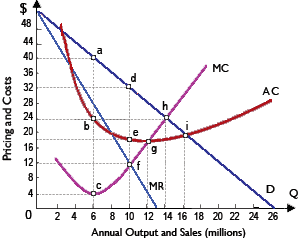
1209_software of Elasticity.png

Hello guys I want your advice. Please recommend some views for above Economics problems.

   Related Questions in Microeconomics

  • Q : Adjust production in profit-maximizing

    Adjust production in all profit-maximizing firms to a level where the marginal: (i) revenue most greatly exceeds average total cost. (ii) revenue curve is at its maximum height. (iii) cost curve is at its lowest point. (iv) cost curve intersects the m

  • Q : Economoic the setting of a price

    the setting of a price ceiling below the equililbrium level will

  • Q : Negative marginal utility The economic

    The economic good becomes an economic bad whenever consumption is expanded into an area where: (1) Sellers experience the moral hazard.  (2) Marginal returns are diminishing. (3) Marginal utility is negative. (4) Buyers suffer from adverse choice. (5) Extreme cho

  • Q : Unlimited liability in a partnership

    The word ‘unlimited liability’ in the partnership signifies that a partner: (1) Pays to begin to the partnership, however can’t be held liable for additional/extra funds. (2) Can be held personally accountable for any and each of the partnership&rsqu

  • Q : Revenue added via selling an additional

    The revenue added through selling an additional unit of output is: (w) demand elasticity. (x) average profit rate. (y) supply elasticity. (z) marginal revenue. How can I solve my Economics problem?

  • Q : Explain about supply curve A supply

    A supply curve which is: (i) vertical is perfectly price elastic. (ii) horizontal is perfectly price inelastic. (iii) linear and goes through the origin has a price elasticity of one. (iv) rectangularly hyperbolic is also unitarily elastic. (v) trapez

  • Q : Oligopoly and Economic Welfare Assume

    Assume that P = MSB and the firms in an oligopoly are in equilibrium where P>MC. This follows that: (1) P=MSC. (2) MSB>MSC. (3) MSB<MSC. (4) oligopolists will gain zero economic profit. (5) the minimum point on the LRATC curve will achieved i

  • Q : Problem on income and substitution

    Jim a vegetarian. All he eats is lettuce and cheese. His original budget constraint and utility maximizing bundle are illustrated in the graph shown below: 1531</span></p>
                                        </div>
                                        <!-- /comment-box -->
                                    </li>
   
   </td>
	</tr><tr>
		<td>
       
      <li>
                                        <div class=

    Q : Monopsonistic exploitation-labor union

    The labor union contracts, a comparable worth rule, or minimum salary laws might boost up equilibrium employment when a firm has been practicing: (i) Price discrimination. (ii) Monopolistic exploitation. (iii) Feather-bedding. (iv) Blacklisting. (v) Monopsonistic expl

  • Q : Analytic Time-The Market Period I have

    I have a problem in economics on Analytic Time-The Market Period and Products Flow Model. Please help me in the following question. According to the Alfred Marshall, the period of time so short that output is fixed is: (1) Chronological run. (2) Marke