--%>

Average cost-aversge variable cost-Marginal cost

Relation between Average cost, aversge variable cost and Marginal cost:
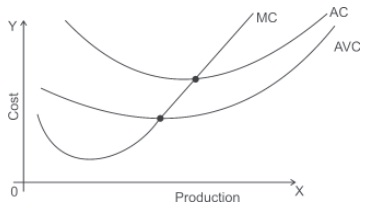
1214_costs.jpg

A) MC interects to AC and AVC at their minimum level

B) AC and AVC decreases before the interection by MC, but remain greater than MC.

C) AC and AVC starts to increase after the itersection by MC, and becomes less than MC.

D) As output increases, AC and AVC tends to be closer but the difference between AC and AVC can naver be zero.

   Related Questions in Microeconomics

  • Q : Industry demand curve identity

    Babble-On maintains world-wide patents for software which translates any of 314 spoken languages within text, along with automatic audio and text translations within any of the other three-hundred-thirteen languages. When Babble-On is a pure monopoly, such firm confro

  • Q : Diminishing Marginal utility principle

    Can someone help me in finding out the right answer from the given options. The experience that your very first kiss with a latest crush was more thrilling and satisfying than your 10th kiss 35 minutes later is an illustration of the: (i) Familiarity principle. (ii) N

  • Q : Social Welfare and Value of Marginal

    I have a problem in economics on Social Welfare and Value of Marginal Product of Labor. Please help me in the following question. The social value of additional output from the additional units of labor is: (i) Marginal revenue of the product of labor

  • Q : Absolute value of price elasticity of

    The absolute value of price elasticity of demand is generally greater when there: (w) are fewer uses for the good. (x) is more time permitted for buyers to adjust. (y) are fewer substitutes for the good. (z) is a lower elasticity of s

  • Q : Demand perfectly price elastic

    Demand is perfectly price elastic when the price for Pixie's cheesy fried grits is a mostly unmeasurably small bit below the: (1) zero. (2) P1. (3) P2. (4) P3. (5) P4.

    Q : Problem on Labor Unions and Wages The

    The Industrial unions try to accomplish wage rates above the competitive level through: (i) Limiting the supply of labor to the industry. (ii) Raising the supply of labor. (iii) Raising the productivity of the labor in an industry. (iv) Member’s agreeing to work

  • Q : Consequences of the price floor

    Consequences of the price floor: The consequences of price floor might be: (A) Surplus of the commodity (B) The government might resort to buffer stocks to absorb the excess in the market at the support price and sells the products to consumers beneat

  • Q : Define change in demand Change in

    Change in demand: When change in demand takes place due to change in factor other than price, it is termed as change in demand.

  • Q : Possessing a problem of Moral Hazard I

    I have a problem in economics on possessing a problem of Moral Hazard. Please help me in the following question. The Moral hazard poses a problem if: (i) People with health insurance acquire flu shots. (ii) Persons who are sicker purchase health insur

  • Q : Effects of price hike in Substitution

    Price hikes for the new cars are probable to cause the demand for employed cars to (1) Shift to the right. (2) Pivot vertically. (3) Shift to the left. (4) Become more horizontal. Can someone please help me in finding out the accur