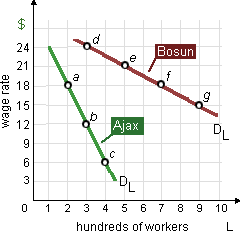
Arc elasticity of demand between two points
The arc elasticity of demand Ajax for labor in between point a and point b is about: (i) 0.25. (ii) 0.50. (iii) 0.75. (iv) one. (v) two. Can someone explain/help me with best solution about problem of Economics...
The arc elasticity of demand Ajax for labor in between point a and point b is about: (i) 0.25. (ii) 0.50. (iii) 0.75. (iv) one. (v) two.
Can someone explain/help me with best solution about problem of Economics...
In addition to price, what are the other determinants that consumers want to buy?
Describe why the equilibrium price of commodity is determined at the level of output at which its demand equavalents its supply.
Shifting from left to right all along demand curve D, the price elasticity of demand for Pixie’s cheesy fried grits will be: (i) Positive, then unitary, and then negative. (ii) Constant and equivalent to one. (iii) More at high prices than at low prices. (iv) Lo
A security which promises to pay a fixed amount of money annually till the issuer purchases this from an owner is termed as a: (i) present value. (ii) future value. (iii) perpetuity. (iv) residual. (v) trust fund.
The market supply schedule for a resource or good shows the: (i) Points in time if production is scheduled for completion. (ii) Amounts sellers wish could be given at prices exceeding the costs. (iii) Maximum quantities which will be offered for sale at particular pri
While marginal cost is positive, a profit maximizing monopolist will control where marginal revenue is: (w) positive. (x) negative. (y) zero. (z) positive, zero, or negative, depending upon elasticity of demand. Q : What is an Indifference curve Indifference curve: It is the combination of two goods that provides consumer similar level of satisfaction.
Indifference curve: It is the combination of two goods that provides consumer similar level of satisfaction.
Can someone please help me in finding out the accurate answer from the following question. The business vice president employs company money to furnish an excessively plush office. This is an illustration of: (1) Corporate surplus in America. (2) The principal-agent p
One of my friends can't discover the solution of this question. So he is not capable to complete his assignment. Give answer of this question. Are there any limits or constraints onto the enterprise’s capability to grow and change?
Oligopoly: This is a form of the market in which there are some big sellers of a commodity and a big number of buyers. There is a high degree of interdependence between the sellers regarding their price and output policy.
18,76,764
1940491 Asked
3,689
Active Tutors
1439048
Questions Answered
Start Excelling in your courses, Ask an Expert and get answers for your homework and assignments!!