--%>

Approximate unitary price elasticity of demand

St. Valentine’s Day software is currently going addicted to version 6.0. The level of output consequent to the point where demand has unitary price elasticity is approximately: (i) 4 million copies. (ii) 6 million copies. (iii) 9 million copies. (iv) 11 million copies. (v) 13 million copies.
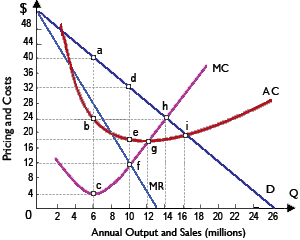
193_software of Elasticity.png

Hello guys I want your advice. Please recommend some views for above Economics problems.

   Related Questions in Microeconomics

  • Q : Problem on financial Intermediation The

    The main reason for the existence of financial intermediaries is as: (1) Direct flows of savings from the individuals to firms would necessitate higher transaction costs. (2) That just wealthy individuals can afford to invest in the stocks and bonds. (3) The habits of

  • Q : Selling of physically indistinguishable

    While physically indistinguishable units of a good are concurrently sold at various prices at various locations, such price differentials reflect: (1) differences within marketing and advertising costs. (2) rational ignorance by consumers. (3) differe

  • Q : Minor Inefficiencies in Monopolistic

    Minor inefficiencies generated since monopolistic competitors differentiate their products may be more than offset through the: (w) increase in economic equity. (x) expansion of the psychologically-meaningful choices obtainable to consumers. (y) reduc

  • Q : Market power at output market The

    The profit-maximizing firm which is perfectly competitive in the resource market however which consists of market power in the output market will hire the labor at a point where: (p) VMP = MRP = MFC = w. (q) VMP > MRP = MFC = w. (r) VMP = MRP = MFC > w. (s) VMP

  • Q : Demands possibly the least income

    Demands are possibly the least income elastic for very poor Americans for: (i) automobile services. (ii) Big Macs. (iii) lard. (iv) housing. (v) health care. Can anybody suggest me the proper expla

  • Q : Imposition of price ceilings The

    The imposition of price ceilings which are below equilibrium generally results within: (w) shortages and net decreases in economic efficiency. (x) more efficient allocations of scarce resources. (y) greater consumer satisfaction and b

  • Q : Freedom of entry in monopolistically

    Along with freedom of entry in a monopolistically competitive market, in long run equilibrium is reached along with firms: (w) earning zero economic profit. (x) producing where price equals marginal cost. (y) producing their most efficient output. (z)

  • Q : Perfect mobility and perfect information

    The model of perfect competition assumes perfect mobility and perfect information. Transaction costs are not present; therefore all buyers and sellers base decisions on the best information obtainable to anyone else, as well as transportation (mobilit

  • Q : Transaction Costs-Process of trial and

    In an uncertain globe, people are supposed to try to make best use of their satisfaction by: (1) Determining in advance the mixture of goods that maximizes the utility and then purchasing this mix. (2) The procedure of trial and error. (3) Making marginal decisions ti

  • Q : Change in Supply versus change in

    Assume that a screen at the front of this room exhibits a graph of supply curve for ice-cream. The shift of this supply curve away from the center of our Earth would replicate: (i) A raise in the quantity of ice-cream demanded. (ii) A reduction in the supply of ice-cr