--%>

Annual total revenue when profit maximizes

When Nostalgia Corporation maximizes profit in its production of Silver Screen DVDs, in that case its annual total revenue will be roughly: (i) $40 million. (ii) $60 million. (iii) $80 million. (iv) $100 million. (v) $120 million.
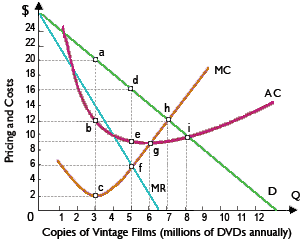
2112_maximize profit.png

Can anybody suggest me the proper explanation for given problem regarding Economics generally?

   Related Questions in Microeconomics

  • Q : Occurrence of increase in supply in

    In short run, the increase in supply takes place whenever the: (1) Supply curve shifts upward and to left. (2) Preferences of consumers change in a positive direction. (3) Market price raise. (4) Amounts producers make accessible rise at each and every price. (5) Publ

  • Q : Interest rates of business investors in

    The interest rates business investors into economic capital should pay on a loan: (w) reflect the opportunity costs to society of funding one investment in place of another. (x) are relatively trivial investment costs by investors&rsq

  • Q : When is marginal costs equivalent to

    A purely competitive firm adjusts production therefore its marginal costs equivalent the market price, thus: (w) minimizing losses or maximizing profit. (x) ensuring that total costs do not exceed total revenue. (y) surviving the shor

  • Q : Hicks Model of Collective Bargaining I

    I have a problem in economics on Hicks Model of Collective Bargaining. Please help me in the following question. The period of union strikes and the equilibrium wage rate at conclusion of a strike are the focus of: (i) Taft-Hartley Act of 1948. (ii) B

  • Q : Elasticity Which of the statements

     Which of the statements regarding elasticity is correct? A) Supply is more elastic in the short run than in the long run. B) Demand is more elastic in the short run than in the long run. C) Demand is more elastic when a large number of substitute goods are avail

  • Q : Expansion of increasing cost industries

    Expansion of the industry in increasing cost industries causes: (w) increases in each firm’s costs at every level of output. (x) decreases in each firm’s costs at every level of output. (y) all firms to suffer long-run economic losses. (z)

  • Q : Demand curves rightward of potential

    Monopolistically competitive firms advertise in try to shift their: (1) own supply curves leftward. (2) competitors' costs upward. (3) existing customers' demand curves leftward. (4) tax burdens to resource suppliers. (5) potential customers' demand c

  • Q : Profits and losses in long run In the

    In the long run: (i) purely competitive firms make zero economic profits. (ii) monopolistically competitive firms make zero economic profits. (iii) effective barriers to entry may permit economic profits. (iv) oligopolists and monopolists may realize

  • Q : The Demand for Loanable Funds An

    An increase during the demand for loanable funds will be mirrored through: (1) an increase in the supply of bonds. (2) a decrease into the interest rate. (3) a lower subjective internal rate of discount through typical savers. (4) a reduction in the f

  • Q : Shutdown level of output for a purely

    For a purely competitive firm the shutdown level of output arises where is: (w) total revenue barely covers total fixed costs. (x) market price just equals the minimum of its AVC curve. (y) total revenue equals total cost as (PQ = TFC + TVC). (z) pric