--%>

Annual total costs of production

When Prohibition Corporation maximizes profit into its production of St. Valentine’s Day software, there annual total costs of it will be around: (1) $180 million. (2) $140 million. (3) $100 million. (4) $80 million. (5) $40 million.
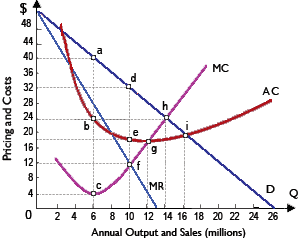
2298_software of Elasticity.png

Can someone explain/help me with best solution about problem of Economics...

   Related Questions in Microeconomics

  • Q : Exploitation and Competitive Markets

    The removal of exploitation of labor (or wage payments beneath the value to the society of each and every individual worker’s productive contribution) is automatic when business decision makers: (1) Should set wages via collective bargaining agreements by labor

  • Q : Variation in supply and demand curves

    These supply and demand curves for housing do NOT involve that the: (w) demand for housing has increased. (x) supply has increased, because rental price has risen. (y) equilibrium price and quantity of housing have increased. (z) housing market will c

  • Q : Revenue expenditure Why payment of

    Why payment of interest is treated as revenue expenditure? Answer: Since it does not cause any decrease in the liability of government.

  • Q : Elasticity of supply Suppose that the

    Suppose that the price of peanut packets increases by 5 %, the quantity supplied of peanut increases by 8 %. Then what is the elasticity of supply? Answer: Es = Per

  • Q : Fixed costs of a purely competitive firm

    The fixed costs of a purely competitive firm are: (w) incurred within the short run even if no output is produced. (x) wage payments and raw materials costs. (y) the bulk of short run opportunity costs. (z) not found by earlier decisions.

  • Q : Demands for consumer for resources

    Since demands for resources eventually depend upon consumers’ demands for goods, in that case the demand for labor is: (w) termed as a derived demand. (x) a perfectly elastic demand curve. (y) a perfectly inelastic demand. (z) a horizontal line.

  • Q : Markets in a capitalistic economy

    Markets within a capitalistic economy answer the “What?” question with: (1) government subsidies which promote new technologies. (2) giving those goods which consumers demand. (3) misleading advertising to persuade consumers to buy. (4) di

  • Q : Increase revenues when price falls When

    When the price elasticity of demand for fried cheesy grits at Pixie’s Breakfast Grill is two, in that case a price cut of $2.80 to $2.00 per serving of grits would be most probably to: (1) reduce Pixie’s revenues from grits by roughly fort

  • Q : Market demand with market power

    LoCalLoCarbo has turn into the favorite of fad dieters. There in illustrated graph curve B shows: (i) LoCalLoCarbo’s marginal cost curve. (ii) LoCalLoCarbo’s average variable cost curve. (iii) LoCalLoCarbo’s average total cost curve. (iv) the market

  • Q : Greatest percentage rate of return The

    The greatest percentage rate of return would be generated through a financial investment which yielded: (w) annual income = $1,000; current price = $10,000. (x) monthly income = $100; current price = $24,000. (y) annual income = $1,200; current price = $10,800. (z) an