--%>

Annual total costs

When Nostalgia Corporation maximizes profit in its production of Silver Screen DVDs, in that case its annual total costs will be around: (i) $45 million. (ii) $65 million. (iii) $85 million. (iv) $105 million. (v) $125 million.
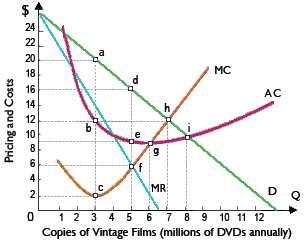
172_maximize profit.png

Hello guys I want your advice. Please recommend some views for above Economics problems.

   Related Questions in Microeconomics

  • Q : Derived Demand for Labor in competition

    The faddish popularity of Atkins and South Beach diets both, and both of that advise dieters to eat more meat and to decrease the intake of starchy carbohydrates, most likely decreased incomes most sharply for: (1) grocery store clerks. (2) cattle ran

  • Q : Equilibrium quantity and price

    Elucidate the consequence of an increase in demand of a commodity on its equilibrium quantity and price? Answer: Increase in demand causes a rightward shift in the

  • Q : Earn zero economic profit by

    When a monopolistic competitor is earning zero economic profit, in that case this: (1) sells at a price equal to average total cost. (2) sells at a price equal to marginal cost. (3) is at the minimum point on its average total cost cu

  • Q : Natural barriers to entry A monopoly

    A monopoly may emerge naturally while: (w) increasing costs happen quickly relative to market demand. (x) at low levels of output, disutilities of scale are encountered. (y) economies of scale are substantial relative to market demand. (z) variable co

  • Q : Elucidate the merits of mixed economy

    Elucidate the merits of mixed economy system?

  • Q : Theory of imperfect competition An

    An extensive theory of imperfect competition was initially developed by: (1) John Maynard Keynes. (2) Antoine Augustin Cournot. (3) Joan Robinson. (4) Joseph Schumpeter. (5) Thorstein Veblen. How can I solve my

  • Q : Diminishing Marginal Utility of a good

    Whenever eating a whole pizza and realizing that the last piece didn’t taste almost as good as the first, you are experiencing is: (1) Diminishing the marginal utility. (2) Law of comparative advantage. (3) Law of income effect. (4) Law of supply.

  • Q : Determine income elasticity of demand

    An income elasticity of demand for mass transit of 0.6 implies that the demand for mass transit is/will: (1) a necessity. (2) a luxury. (3) rise at a slower rate than income. (4) fall when income rises. How can I s

  • Q : Tax cutting affect the economy How does

    How does tax cuts affect the economy?

  • Q : Problem regarding analyzing persistent

    In analyzing persistent shortages within the U.S. market for adoptable children: (w) children are most reasonably considered investment goods. (x) children might reasonably be functioned as consumer goods. (y) lower prices charged adopting families would result within