--%>

Annual economic profit of production

When point e corresponds to $18 per copy for St. Valentine’s Day software, so Prohibition Corporation can produce annual economic profit of at most just about: (i) $100 million. (ii) $140 million. (iii) $200 million. (iv) $300 million. (v) $400 million.
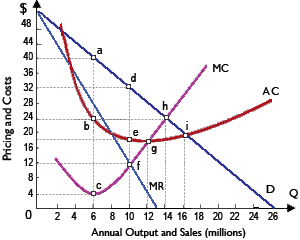
250_software of Elasticity.png

Hello guys I want your advice. Please recommend some views for above Economics problems.

   Related Questions in Microeconomics

  • Q : Problem on equilibrium price Refer to

    Refer to the following data. Equilibrium price will be:  A) $4. B) $3. C) $2. D) $1. Give the answer of above questaion

  • Q : Income floor by marginal tax rate A

    A marginal tax rate of 75 percent and an income floor of ____ give in a break-even level of income of $8,000. (w) $2,000. (x) $4,000. (y) $6,000. (z) $16,000. Hello guys I want you

  • Q : Profit Maximization and the Demand for

    Each and every profit-maximizing firm which can cover its variable costs will hire the labor: (1) Just to the point of the diminishing returns. (2) Just to the point where MRP = ARP for the final worker hired. (3) Beyond the point of the diminishing r

  • Q : Economic profit of purely-competitive

    This purely-competitive lumber mill experiences on the average day is an: (w) economic profit of about $340. (x) economic loss of roughly $150. (y) accounting profit of less than $300. (z) accounting loss of more than $100.

    Q : Long Run-Firm can vary all inputs I

    I have a problem in economics on Long Run-Firm can vary all inputs. Please help me in the following question. In long run: (1) Firm can vary all the inputs. (2) Firm can vary few inputs, however not all. (3) Capital starts to depreciate. (4) Output increases.

  • Q : Determine total annual revenue As per

    As per this illustrated figure as in below, the total annual revenue of Robot Butlers, Inc. will be greatest when this produces and sells as: (w) 5,000 Robot Butlers. (x) 10,000 Robot Butlers. (y) 15,000 Robot Butlers. (z) 20,000 Robot Butlers. <

  • Q : Analytic time in market structure In

    In this figure the firm probably to go out of business the soonest would be as: (w) Firm A. (x) Firm B. (y) Firm C. (z) Firm D. 298_Market Str</span></p>
                                        </div>
                                        <!-- /comment-box -->
                                    </li>
   
   </td>
	</tr><tr>
		<td>
       
      <li>
                                        <div class=

    Q : Profits and Losses in firms Of all the

    Of all the profits made by the U.S. firms, corporations account for regarding: (1) Less than 10 percent. (2) Between 10 percent and 20 percent. (3) Between 20 percent and 40 percent. (4) More than 40 percent. Can someone please hel

  • Q : Harmness of price discrimination Price

    Price discrimination generally harms: (w) all consumers and benefits firms along with market power. (x) all firms along with market power and benefits all consumers. (y) some consumers, when helping sellers and several other consumers. (z) all sellers

  • Q : Yellow Dog Contracts-non-union

    The worker who signed a yellow dog contract in the year 1920s agreed: (i) To support the union’s feather-bedding efforts. (ii) Not to work with the ‘scab’ non-union strike-breakers. (iii) To pay the union dues as protection from the violent union org