--%>

Annual economic profit

When point e corresponds to $9 per copy for Silver Screen DVDs, Nostalgia Corporation can produce annual economic profit of at mostly about: (i) $25 million. (ii) $35 million. (iii) $50 million. (iv) $75 million. (v) $100 million.
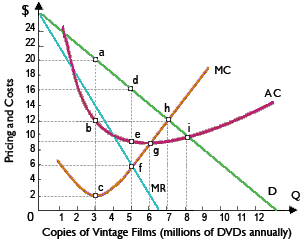
1723_maximize profit.png

I need a good answer on the topic of Economics problems. Please give me your suggestion for the same by using above options.

   Related Questions in Microeconomics

  • Q : Vigorously competitive market

    Economic rents which can be capitalized are least possible to arise by: (1) production cost advantages. (2) proprietary knowledge. (3) being first to market a differentiable new product or to innovate a new production technology. (4) a vigorously comp

  • Q : Positive sloped labor supply curve Can

    Can someone help me in finding out the right answer from the given options. The monopsonist in labor market faces a: (1) Totally elastic demand for labor. (2) Completely elastic supply of the labor. (3) Completely inelastic supply of the labor. (4) Positively sloped l

  • Q : Total variable costs in pure competition

    This profit-maximizing, as in demonstrated graph, of brickyard’s total variable costs are about: (i) $200 per day. (ii) $600 per day. (iii) $750 per day. (iv) $900 per day. (v) $1200 per day.

  • Q : Relatively price inelastic and consumer

    When demand for a consumer good is relatively price inelastic, in that case the: (i) total spending of consumers will decline when the price rises. (ii) demand curve is linear and vertical. (iii) price of the good is determined through supply alone. (

  • Q : Competition and Social Welfare The

    The purely competitive firm in an output market which hires from a purely competitive labor market will use labor at the point where VMP = W as the firm: (i) Operates in the society's best interest. (ii) Wants to be pretty fair to workers. (iii) Is eg

  • Q : Price elasticity and market power The

    The price elasticity of demand equals one when this firm produces where total revenue is: (i) $72,000 per period. (ii) $80,000 per period. (iii) $96,000 per period. (iv) $100,000 per period. (v) $144,000 per period.

    Q : Describe proportional in taxes as

    Line T1 depicts in given graph as in below a tax system which is: (i) progressive. (ii) recessive. (iii) proportional. (iv) biased. (v) regressive.

    Q : Determine the market price when demand

    When both demand and supply rise within the market for cell phones, we would suppose the market price to: (w) increase. (x) decrease. (y) increase, decrease, or stay similar, depending upon the relative magnitudes of the shifts. (z) s

  • Q : Post tax and post transfer income

    As measured through post tax and post transfer income patterns, from World War II, then the U.S. has created: (w) no progress in reducing the gap in between the rich and poor. (x) substantial progress in reducing the gap in between rich and poor. (y) moderate progress

  • Q : Marginal revenue in kinked-demand model

    Into this "kinked-demand" model, such firm views the marginal revenue curve this faces as the: (1) linear curve acD2 for all prices. (2) linear curve deMR1 for all prices. (3) nonlinear curve adeMR1. (