--%>

Ambrose’s budget constraint

Question:

Ambrose consumes two goods, peanuts (x1 ) and a composite good (x2). He has a utility functionU = 4 √x1 + x2. This means his MU1 = 2/ √x1 and his MU2 = 1 . The current prices are p1 = 0.5 per kilogram and. p2 = 1. His budget is $20 per month.

(a) Write down Ambrose's budget constraint?

(b) What are the optimal quantities of peanuts and x2 for Ambrose to consume? How much utility will he get?

(c) Suppose that rationing by the government means that Ambrose is allowed to purchase no more that 12 kilograms of peanuts per month. Now how much x1 and x2 will Morgan consume? Show the effect of rationing using a diagram. Be sure to label you diagram completely.

(d) Suppose that instead of rationing peanuts the government decides to tax them. The tax is $0.5 per kilogram. How much x1 and x2 will Morgan consume? How much utility will he get?

(e) How much would Ambrose need to be compensated to make him as well of as if peanuts had not been taxed?

Solution:

a) P1 = 0.5, P2 = 1, m = 20

Therefore, the budget constraint is,

0.5x1 + x2 = 20

b) U = 4 Öx1 + x2. P1 = 0.5, P2 = 1

MRS = MU1/ MU2 = (2/Öx1)/1 = 2/Öx1

Now, MRS = P1/P2 = 0.5/1 = 2/Öx1

  1.   Öx1=2/0.5
  2.   x1 = 4/0.25 = 16
  3.   x2 = (20 - 16x 0.5) = 12

Utility derived = 4(16)0.5 + 12 = 28

c) If x1 is rationed to 12 units, x2 = 20 - 12x 0.5 = 14
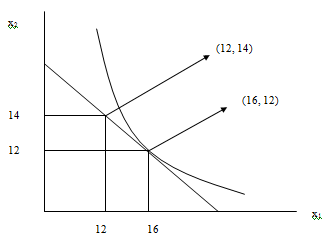
351_effect of rationing.png

d) P1 = 0.5 + 0.5 = 1, P2 = 1, m = 20

MRS = P1/P2 = 1/1 = 2/Öx1

  1.   Öx1=2
  2.   x1 = 4
  3.   x2 = (20 - 4x 0.5) = 18

Utility derived = 4(4)0.5 + 18 = 22

e) 4(4)0.5 + x2 = 28

  1.   4 + x2 = 28
  2.   x2 = 28-4 = 24
  3.   Extra money required = 24 - 18 = 6

   Related Questions in Business Economics

  • Q : Forcast 9. The following table shows

    9. The following table shows annual sales data for Stuff Happens, Inc., over the ten-year 1998-2008 period: Year Sales ($ Millions) 1998 $2.0 1999 2.2 2000 2.4 2001 2.6 2002 2.8 2003 3.0 2004 3.2 2005 3.5 2006 3.8 2007 4.1 2008 4.3 A. Calculate the 1998-2008 growth rate in sales using

  • Q : Illustrate the 4th role is the

    Illustrate the 4th role is the reallocation of resources?

  • Q : Who will get the goods and services Who

    Who will get the goods and services?

  • Q : Significant that economics is not a

    Why is it significant that economics is not a laboratory science?  What problems may be evolved in deriving and applying economic principles?

  • Q : Determine the monetary prices while

    Dividing monetary prices from each other yields: (v) nominal prices. (w) relative prices. (x) subjective prices. (y) absolute prices. (z) transaction prices. Hello guys I want your advice. Please recommend some vie

  • Q : Illustrate how Macroeconomics examines

    Illustrate how Macroeconomics examines the economy as a whole?

  • Q : Meaning of Modigliani-Miller Briefly

    Briefly describe the meaning of Modigliani- Miller (M and M) approach?

  • Q : Production function for the game

    Question Can you describe what the production function for the game looks like? (How are labour, capital and resources combined? Are there constant, increasing or decreasing returns to scale?) Answer

    Q : Self-interest theory demonstration by

    The model of _____ was demonstrated by _____ along with the quote, “The loss of a small finger would remain the average European by sleeping which night, ... but, given he never observed them, he will snore with the most profound security over the loss of millio

  • Q : Limitation of intermediaries for

    Intermediaries do not classically: (w) reduce transaction costs. (x) absorb risk. (y) try to make profits. (z) cause prices to be more volatile. I need a good answer on the topic of Economic problems. Please give m