--%>

Alpha's and Beta's profits

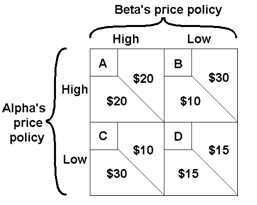
Refer to the below diagram where the numerical data illustrates profits in millions of dollars. Beta's profits are illustrated in the northeast corner and Alpha's profits in the southwest corner of each cell. If Alpha and Beta engage in collusion, the outcome of the game will be at cell: 1) A. 2) B. 3) C.  4) D.
678_jhhhhhk.png

   Related Questions in Microeconomics

  • Q : Drive rivals out of business A firm may

    A firm may temporarily lower prices as well as earn negative profits in trying to: (w) drive rivals out of business. (x) find rivals to lower prices. (y) maximize current profit. (z) A rational firm would not do this.

    Q : Market price below equilibrium price

    When the market price is beneath the equilibrium price then: (i) The market will clear. (ii) An excess exists. (iii) Consumers will not invest. (iv) The shortage exists. (v) Each and every consumer will be satisfied. Find out the r

  • Q : Consequences of rise in union wages Can

    Can someone help me in finding out the right answer from the given options. The possible consequences of a rise in union wages comprise reduced: (1) Union employment and a refusal in non-union wages. (2) Shares of national income to the labor however growth of union e

  • Q : Minimum of the average variable cost

    Short-run supply curve of a purely competitive firm’s is: (w) its MC curve above the minimum of the AVC curve. (x) the upward sloping part of its ATC curve. (y) the intersection where is MR = MC. (z) horizontal up to the firm’s productive

  • Q : Statement of Law of Demand The law of

    The law of demand defines that when a good’s price increases, its quantity demanded will drop: (1) No matter what occurs to other variables. (2) When all as well is supposed constant. (3) Since its demand curve shrinks. (4) If substitutes become

  • Q : Strikes and Lockouts Can someone please

    Can someone please help me in finding out the accurate answer from the following question. The outcomes of strikes do not comprise: (i) Losses of the perishable products. (ii) Shipping delays. (iii) Decreased production costs. (iv) Shortages.

  • Q : Demand curves of monopolistic

    Monopolistic competitive firms face: (w) perfectly elastic demand curves. (x) perfectly inelastic demand curves. (y) downward sloping demand curves. (z) the industry demand curves. Hello guys I want your advice. Pl

  • Q : Lowest price in shopping for expected

    Consumers shop for the lowest price probable for a good only till the expected benefits of shopping no longer go beyond the expected: (w) maximum legal prices for the good. (x) prices available in the black market. (y) transaction costs related with a

  • Q : Positive relationship by law of supply

    The law of supply defines that there is a positive relationship among: (1) The Price and quantity supplied. (2) Technology and production. (3) Purchases and the accessibility of goods. (4) Supply and the demand it makes.

    Q : Relation between Implicit Costs and

    I have a problem in economics on Relation between Implicit Costs and Opportunity costs. Please help me in the following question. The Implicit costs are: (1) Opportunity costs. (2) Always variable costs. (3) Similar as the accounting costs. (4) Similar as the explicit