--%>

All possible prices exceeding in equilibrium for buyers

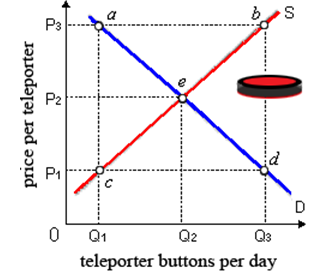
Participants in this market would experience a surplus in this market for teleporter buttons: (1) at all possible price per button exceeding P2. (2) equal to distance cd when the price per button equals P1. (3) when this market was primarily in equilibrium, and in that case the government imposed a tax equal to P2-P1 on teleporter button production. (4) at every price where demand exceeds the supply of teleporter buttons (1) eliminating the shortage Q1-Q3 existing at P3. (5) when teleporter button manufacturers began exporting the buttons to China.
48_Equilibrium for Buyers.png

Please choose the right answer from above...I want your suggestion for the same.

   Related Questions in Microeconomics

  • Q : Product differentiation in gain

    Monopolistic competitors: (1) base decisions on the anticipated reactions of their many individual competitors. (2) can easily enter but not exit industries. (3) may sometimes act like monopolists and gain economic profits in the short run because of

  • Q : Monopolistically competition in long

    When a monopolistically competitive firm is in long-run equilibrium, in that case this is unlikely for: (w) MR = MC. (x) P to be greater than MC. (y) P to be greater than the minimum of the long run average cost curve. (z) accounting

  • Q : Problem on Complementary Goods From the

    From the viewpoints of auto makers, the weakening of OPEC oil cartel in the year 1990s resulted in a/an: (1) Rise in demand for cars. (2) Reduction in demand for cars. (3) Rise in the supply of cars. (4) Reduction in supply of cars.

    Q : Occurrence of natural barriers to entry

    Natural barriers to entry within a market arise primarily by: (w) strategies by existing firms to discourage the entry of new firms. (x) perfectly inelastic demands for products. (y) the declining cost structure inherent in producing specific goods. (

  • Q : Problem on Supply Prices Can someone

    Can someone please help me in finding out the accurate answer from the following question. The relative monetary values organizations put on selling a bit more or less of a good are termed as: (i) Supply curves. (ii) Gain-maximizing prices. (3) Supply prices. (4) Pric

  • Q : Saving transaction costs by locations

    Economic rent by a parcel of land is positively associated to the: (w) savings in transaction costs yielded by its location. (x) amount of idle land adjacent to this. (y) time this has been held by the current landowner. (z) amount of natural flora an

  • Q : When would transaction cost be zero All

    All transaction costs would be zero when: (1) Congress required current prices to be cut by eighteen percent. (2) market information and transportation were both costless. (3) market prices were legally restricted to production costs. (4) inflation we

  • Q : Earning income under negative income tax

    Under the negative income tax system demonstrated in this figure, a family of four along with earned income of $15,000 yearly would have a net [after-tax] income of: (i) $30,000 per year. (ii) $27,500 per year. (iii) $25,000 per year.

  • Q : Pure competition and monopolistic

    Monopolistically competitive and purely competitive industries tend to be described by: (i) important economies of scale in production. (ii) many potential buyers and sellers. (iii) horizontal demand curves facing each firm. (iv) conscious interdepend

  • Q : Consumers arrival at a point-law of

    According to law of diminishing marginal utility, the consumer inevitably arrives a point where: (i) Net satisfaction derived from good declines. (ii) Consumer suffers from total satiation from some good. (iii) Extra satisfaction outcome by extra unit