--%>

Aggregate expenditure

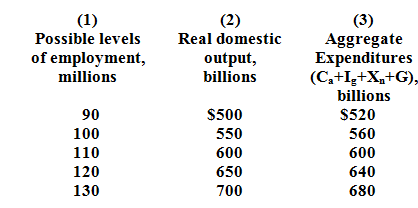
Refer to the table below in answering the questions which follow:
1308_inflationary expenditure gap or recessionary expenditure gap.png


Will there be recessionary expenditure gap or inflationary expenditure gap if the full-employment level of output is $500 billion?  Describe the consequences. By how much aggregate expenditure in column 3 ought to change at each level of GDP to remove the gap? Explain. Illustrates the multiplier in this example?


E

Expert

Verified

An inflationary gap. Aggregate expenditures will be excessive, causing demand-pull inflation. Aggregate expenditures ought to fall through $20 billion (= $520 billion -$500 billion) at each level of GDP to remove the inflationary gap. The multiplier is yet 5 – the level of full employment GDP does not influence the multiplier.

   Related Questions in Finance Basics

  • Q : Describe the terminal value calculation

    Describe the terminal value calculation at the ending of the forecast period. Why is it crucial? The firm which business operation is being valued is not accepted to suddenly cease operating at the ending of the discrete forecasting period, how

  • Q : What is Reverted Appropriation Reverted

    Reverted Appropriation: An appropriation which is reverted to its fund source after the date its liquidation period has terminated.

  • Q : What is Service Revolving Fund Service

    Service Revolving Fund: A fund employed to account for and finance most of the client services provided by the Department of General Services. The amounts expended by the fund are repaid by sales and services priced at rates adequate to keep the fund

  • Q : Why do companies extend trade credit

    Accounts receivable are sometimes not gathered. Why do companies extend trade credit while they could insist on cash for all sales? Extending trade credit approximately leads to more sales for all time. If the incremental cash flows, comprisin

  • Q : Question related to MPC Normal 0 false

    Normal 0 false false

  • Q : Describe capital rationing Describe

    Describe capital rationing? Should a firm practice capital rationing? Why? Capital rationing is the practice of setting dollar restriction on what will be invested in new capital budgeting projects. Proprietorships, partnerships and private c

  • Q : Compare and contrast the book value and

    Compare and contrast the book value & liquidation value per share for common stock. Is one method more reliable? Describe.The Book Value of a firm's common stock is found by subtracting the value of the firm's liabilities, and preferred stoc

  • Q : Define Non-add Non-add : Refers to the

    Non-add: Refers to the numerical value which is displayed in parentheses for informational purposes however is not comprised in computing totals, generally as the amounts are by now accounted for in the budget system or display.

  • Q : Define Pooled Money Investment Board

    Pooled Money Investment Board (PMIB): The board included of the Director of Finance, State Treasurer, and the State Controller, the aim of which is to design an efficient cash management and investment program, employing all monies fl

  • Q : Question based on consolidated balance

    Normal 0 false false