--%>

Affects of costs and revenues in monopolistic competition

When the relative positions of all affects on costs and revenues are the same for all the several firms in this industry, in that case this firm is most likely operating in a: (w) differentiated oligopoly market in the short run. (x) monopolistically competitive market in long run equilibrium. (y) cartel in short run equilibrium. (z) homogeneous oligopoly within ling run equilibrium.
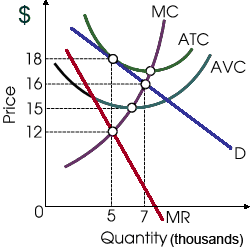
739_Monopolistic Competition1.png

Please choose the right answer from above...I want your suggestion for the same.

   Related Questions in Microeconomics

  • Q : Agency Shop Agreements Can someone

    Can someone please help me in finding out the accurate answer from the following question. Labor contracts having agency shop arrangements need: (1) Employees of a firm to give dues to the union. (2) The firm to hire just union members. (3) New employees of the firm t

  • Q : Problem on Transaction Costs Higher

    Higher income families are far-off more probable to purchase automatic garage door openers than people with the lower incomes primarily as automatic garage door openers: (1) Save time and give convenience that wealthy people value relatively more. (2) Are status symbo

  • Q : Resources flowing toward industries in

    Resources tend to flow toward industries in the long run along with: (w) lower profits for typical firms. (x) more profit for typical firms. (y) lower payments to most resource owners. (z) more stable rates of technological change.

    Q : Earning zero economic profit Within a

    Within a monopolistically competitive industry along with no barriers to entry, long run equilibrium will be reached along with the firms into the industry: (1) maximizing total revenue. (2) producing their most efficient outputs. (3)

  • Q : Reinforces the substitution effect For

    For normal goods which experience price changes, then the income effect: (i) Recognizes how higher money income influences demands for goods. (ii) Invalidates the diminishing marginal utility law. (iii) Offsets the substitution effect. (iv) Reinforces the substitution

  • Q : Unexpected inventory growth of price

    These supply and demand curves within the sugar market specify that: (w) a price floor of P0 for sugar will cause a surplus. (x) a price ceiling of P2 will cause a shortage. (y) the market clears while quantity equals Q0

  • Q : Managerial slack or X-inefficiency

    X-inefficiency (also termed as managerial slack): (1) tends to drive up fixed costs. (2) commonly results from firms not being hard pressed through competitors. (3) can absorb much of a monopoly’s potential profit. (4) is a prob

  • Q : Increasing economic profits in a

    Rising economic profits within a competitive market do NOT produce pressures for: (i) expansions of existing firms. (ii) entry by new firms. (iii) price hikes. (iv) increases in costs for specialized resources. (v) ultimate erosion of

  • Q : Output produces by monopolistic

    This monopolistic competitor generates Q0 output where is: (1) MR = MC. (2) MSB > MSC. (3) average cost is not minimized. (4) P = ATC. (5) All of the above.

    Q : Taft-Hartley Act and Closed Shops Can

    Can someone help me in finding out the right answer from the given options. The Taft Hartley Act of 1946 made it illegal to encompass a: (1) Right-to-work law passed by the state legislature. (2) Conviction for the misdemeanor and serve as union officer. (3) Union for