--%>

Absolute value for price elasticity of demand

The price elasticity of demand for Robot Butlers includes the greatest absolute value at an exact price of: (i) $20,000. (ii) $16,000. (iii) $12,000. (iv) $8,000. (v) $4,000.
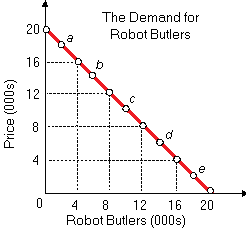
507_Price Elasticity of Demand3.png

How can I solve my Economics problem? Please suggest me the correct answer.

   Related Questions in Microeconomics

  • Q : Determine marginal revenue in

    Assume that a monopolist can sell ten gallons of dehydrated water to backpackers of $10.00 each, however selling 11 gallons forces a price cut of $9.95. Then marginal revenue is: (w) $10.00. (x) $9.95. (y) $9.45. (z) $9.40.

  • Q : Effect of change in market price I have

    I have a problem in economics on Effect of change in market price. Please help me in the following question. The change in quantity demanded is: (1) Non-quantitative in nature. (2) Caused by the change in market price. (3) Shown by the shift of demand curve. (4) Irrel

  • Q : Quantity demanded and goods price The

    The law of demand defines that there is a negative relationship among: (1) A good’s price and quantity demanded. (2) Limitless demands and inadequate resources. (3) The quantities demanded and supplied. (4) People’s income and demands for

  • Q : Reform welfare mess Proposals to reform

    Proposals to reform the “welfare mess” comprises: (w) increasing education levels. (x) increasing job training programs. (y) enforcement of the Equal Pay Act. (z) negative income taxes. How can I solve

  • Q : Numerical problem on Relative Prices

    When the market price of a gallon of gas is similar as the cost of 4 pineapples in dollars, the relative price of the pineapple is: (i) 1/4 of a gallon of gas. (ii) 25 cents. (iii) 4 gallons of gas. (iv) $4.00. Can someone please h

  • Q : Emergence and development of common

    The economist most intimately identified along with the emergence and early development of common equilibrium analysis was: (w) Adam Smith. (x) Leon Walras. (y) Alfred Marshall. (z) William Stanley Jevons. Can some

  • Q : Problem on greatest monopsony power The

    The Employers would have the maximum monopsony power in dealing with: (i) White collar labor in the metropolitan area. (ii) Unionized workers. (iii) Professional athletes. (iv) Blue collar labor in metropolitan area.

    Q : Occurrence of natural barriers to entry

    Natural barriers to entry within a market arise primarily by: (w) strategies by existing firms to discourage the entry of new firms. (x) perfectly inelastic demands for products. (y) the declining cost structure inherent in producing specific goods. (

  • Q : Tax on a good tends to make The tax on

    The tax on a good tends to make: (i) Inflationary pressure the govt. can disperse by cutting its spending. (ii) The wedge among prices buyers pay and the prices sellers obtain. (iii) Rises in supply from the viewpoint of buyers. (iv) More quick transa

  • Q : Long-run equilibrium price paid Pure

    Pure competitors in a long-run equilibrium are paid a price which: (i) allows recovery of any previous operating losses. (ii) equals MC although exceeds average cost. (iii) maximizes average revenue minus average cost. (iv) equals maximum long run ave